

Testing of the world’s longest wind turbine blade
The LM 88.4 P test blade arrived at BLAEST on 1st July, 2016, after being transported from LM Wind Power’s Pilot Plant in Lunderskov. In four weeks the static test was successfully completed.
The LM 88.4 P demonstrated that it can withstand extremely high winds. In the next few months a fatigue test involving the shaking the blade up and down several million times was conducted to determine the durability, longevity, and the ability to survive 25 years of offshore operation.
For the rest of 2016, two LM 88.4 P blades will be tested simultaneously: one at LM Wind Power’s Lunderskov Test Centre, and one at the BLAEST test facility. The parallel testing program will provide results over a 7-month duration – to ensure that the blade meets its design requirements, in half the time normally required for testing.
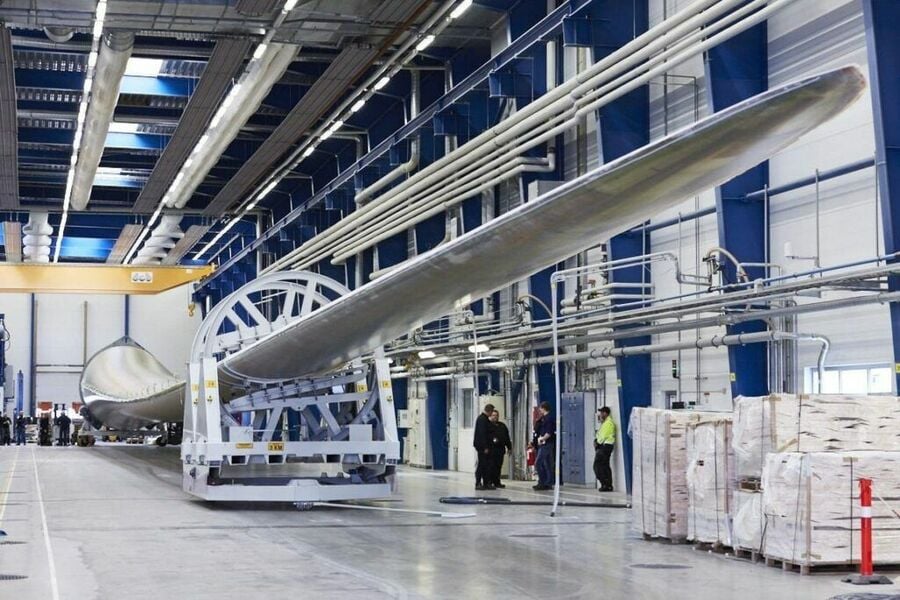
The BLAEST test centre is co-owned by the leading wind technology institutes Force Technology, Technical University of Denmark (DTU – Risø) and Det Norske Veritas DNV Germanischer Lloyd. BLAEST operates several test stands for testing the strength and fatigue of wind turbine blades.
BLAEST Test Centre has been using Gantner Instruments strain gauge technology for several years. Several systems with up to 100 channels per measuring setup record the strain signals dynamically, synchronously and precisely. The modules Q.bloxx A116 and the test controller Q.station were used.
Testing is performed in cooperation with our Danish partner IPC Teknik ApS.
More articles
Measurement of voltage and current in high voltage systems!
With the new measurement technology from Gantner Instruments, the Q.raxx slimline A127 4CV. But what is hidden behind the new DAQ system?
Read more...The A136 Strain Gage Amplifier: Redefining Precision Measurement
The new I/O module for 1kOhm strain gages and semiconductor-based sensors that require 10V excitation.
Read more...Q.series X A101 SV: Universal Measurement Module with Sensor Supply
The Q.series X A101 2 x DB15HD SV module from Gantner Instruments is a precisely engineered multi-functional measurement module that seamlessly integrates into a variety of industrial applications. With 2 universal analog inputs and a programmable sensor supply voltage and current limit, this module is crafted to provide precise and reliable data across a spectrum of measurement needs.
Read more...3 ways advanced DAQ solutions help the aviation industry transition to a sustainable future
By 2050 we need to become a carbon-neutral society, and the aviation sector needs to contribute. While flying less can help reduce emissions, we have options for cleaner air travel. For one, we could power our flight with electricity or hydrogen, which are no longer ideas in some futuristic science fiction novel. Rather, they are on the brink of generating a shift in aviation technology.
Read more...