


More industrial teams are being asked to deliver connected test, monitoring, and data acquisition systems — without a matching increase in internal engineering resources for integration, cabinet design, software setup, and commissioning. The pressure isn’t on any single component. It’s on everything that has to work together..
A measurement system is more than DAQ hardware. The highest project risk often appears between the components: sensor concept, wiring, cabinet layout, power supply, controller, software, communication, data access, and commissioning. Each of these can be solid on its own and still fail as a system if nobody owns the interfaces between them — and it’s exactly that alignment, not any single component, that decides whether the data on the other end is reliable. See the full pain points breakdown on our Turnkey Measurement Systems page.
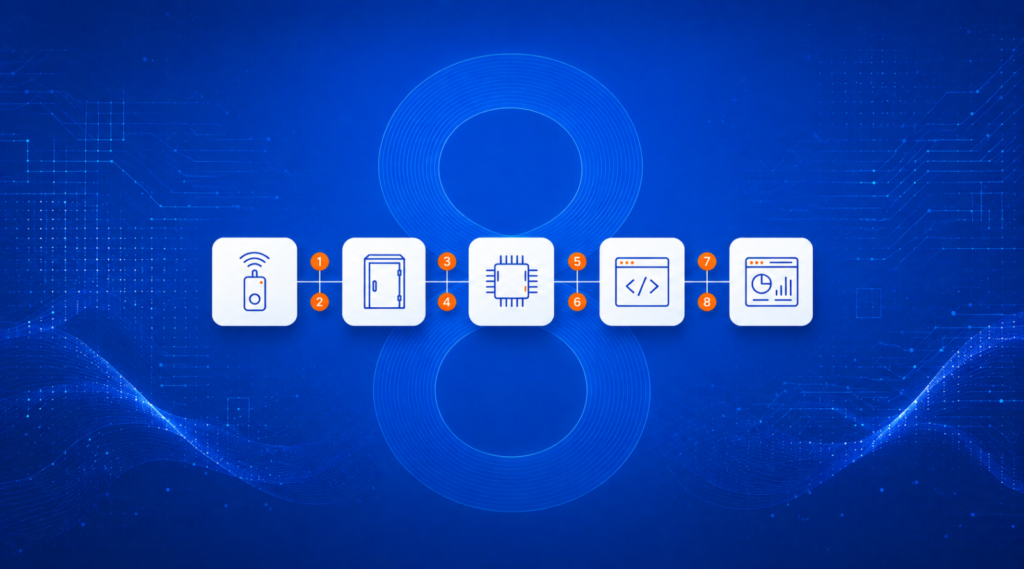
Here are the 8 places where that risk typically hides — and what closes the gap.
- Too Many Interfaces Sensors, DAQ, cabinets, software, cameras, and cloud systems all have to work together. Every interface you add — a connector, a protocol, a software handoff — is a place data quality or schedule can slip. A system built as one architecture, with DAQ hardware such as the Q.series X platform, edge devices like Q.monixx, and software such as GI.bench designed to work together from the start, removes interfaces instead of adding them.
- Wrong Sensor Concept The wrong sensor choice can reduce data quality before the DAQ system ever starts measuring. Vibration sensors, weather stations, temperature sensors, current transducers, strain and displacement sensors, and IP cameras each carry different signal conditioning and sampling requirements — see the full sensor selection range. Get the concept wrong early, and no amount of downstream processing recovers what was lost at the sensor.
- Complex Wiring Sensor wiring, power supply, protection, communication, and cabinet layout have to be planned together, not sequentially. Treating wiring as an afterthought once the DAQ hardware is chosen is one of the most common sources of rework during installation.
- Missing Time Alignment Measurement data, controller data, and optional video data must be synchronized for reliable analysis. Without a shared timestamp across every signal path, correlating events later — a fault, a load spike, a defect — becomes guesswork instead of analysis.
- Difficult Field Operation Outdoor and remote systems need stable power, communication, and local data storage, often with no technician standing by to fix a broken link. Decisions about cabinet design and the key details that make the difference made months earlier are what determine whether that system stays reliable in the field or becomes an expensive site visit.
- Late Commissioning Issues Integration problems often surface during installation or startup — and by then, they’re expensive to fix. A wiring conflict, a missing channel, a software mismatch: caught during commissioning, these turn into budget and schedule overruns instead of design details.
- Disconnected Data Data is often available but not structured, visualized, or accessible to the people who need it. A system can be technically live and still miss its purpose if a vibration trend or a load reading never reaches the engineer who has to act on it, in a form they can use.
- Scaling Problems A prototype can work. A repeatable system needs documentation, architecture, and consistent configuration. What gets a single test bench running rarely survives the jump to ten test benches — or a fleet of distributed field units — without a defined architecture behind it.
Closing the Gap: One Architecture, Not a Parts List
Gantner Instruments aligns the complete measurement chain early in the project through our Customized Solutions. The cabinet is treated as part of the system architecture from the start, so sensors, DAQ, controller, software, and data access work together as one system rather than being integrated after delivery. That work follows a defined six-step workflow: understand the application, define the sensor concept, design the system architecture, configure and integrate, test the system, and deliver with startup support.
The result shows up as concrete solution components: customized connectors that reduce wiring effort, an industrial display for local status and diagnostics, cabinet designs that match the installation concept — from mobile trolley to fixed cabinet — and industrial-grade design for stable operation in demanding environments. For power and energy applications, systems can integrate high voltage measurement up to ±1,500 VDC. Measurement data connects to existing tools through GI.bench, GI.cloud, and test.con, with open interfaces to MATLAB, LabVIEW, and Python. And because the architecture is defined once, a first prototype can scale into a repeatable build for OEMs, multiple test benches, or distributed monitoring systems — see the full benefits overview.
None of this replaces good components. It’s what makes good components add up to a system that delivers reliable data from day one — instead of a set of parts your team has to integrate on-site.
Send us your channel list, sensor types, cabinet requirements, and data interface needs, and we’ll help you turn your measurement task into one integrated system architecture. More on the full offering: Turnkey Measurement Systems.
More articles
German Aerospace Congress 2026
Connect with the aerospace community and explore the latest innovations in research and technology.
Read more...AEWG General Meeting 2026
Connect with experts in acoustic emission technology and explore practical solutions for today’s measurement challenges in a collaborative environment.
Read more...Automotive Test Automation
With an increasing pressure to reduce CO2 emissions, E-mobility is a fast-growing market. While keeping this in mind, Gantner Instruments successful Q.series product line offers the best performance with maximum flexibility, to meet the growing demand for E-Mobility Battery Testing and Battery Management Systems.
Read more...Q.series X A192
The Multifunction Module when Flexibility and the Highest Performance Matters Most
Read more...