space
Testing
Gantner’s DAQ systems deliver precise, synchronised measurements of strain, temperature, pressure, vibration, force, and other sensor data during spacecraft qualification, thermal vacuum, structural, and propulsion testing.
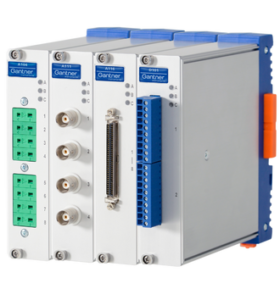
From rocket engine hot-fire testing to spacecraft qualification, Gantner Instruments’ Q.series X data acquisition systems deliver precise, synchronised measurements for the most demanding space test applications. With a modular, distributed architecture, high-speed mixed-signal acquisition, and seamless integration into test facilities, Q.series X supports rocket engine testing, space simulation and environmental testing, structural testing, and vibration & shock testing. The result is trusted test data to verify performance, reduce risk, and ensure mission readiness.
Rocket engine testing verifies the performance, reliability, and safety of propulsion systems under realistic operating conditions by measuring pressure, temperature, vibration, strain, force, and other critical parameters during hot-fire and static-fire test campaigns.
Space simulation and environmental testing verifies that spacecraft, satellites, payloads, and components can withstand the thermal, vacuum, and environmental conditions encountered during launch and throughout their operational lifetime.
Structural testing verifies the strength, stiffness, and structural integrity of spacecraft, satellites, payloads, and launch vehicles by measuring strain, displacement, force, and deformation under representative static and dynamic loading conditions.
Vibration and shock testing verifies that spacecraft, satellites, payloads, and components can withstand the dynamic loads, vibrations, and shock events experienced during launch, separation, and operation without compromising structural integrity or performance.
Why Gantner Instruments for Space Testing?
Deterministic, Nanosecond-Synchronised Measurements
Deterministic, nanosecond-synchronised measurements enable precise time alignment of distributed sensor data across the entire test article. This allows engineers to accurately correlate transient events, analyse structural response, validate subsystem interactions, and verify spacecraft performance during rocket engine, vibration, structural, and environmental qualification testing with complete confidence in the measurement data.
High-Speed Mixed-Signal Data Acquisition
High-speed mixed-signal data acquisition enables the simultaneous measurement of dynamic and static parameters within a single, synchronised data acquisition platform. Engineers can correlate strain, vibration, temperature, pressure, force, and electrical signals to capture fast transient events, validate subsystem performance, and gain deeper insight into spacecraft and propulsion system behaviour throughout qualification testing.
Distributed DAQ Architecture for Large Test Facilities
A distributed DAQ architecture places measurement modules close to the sensors, reducing analogue cable lengths, minimising electromagnetic interference, and preserving signal integrity. This scalable approach simplifies instrumentation of large spacecraft, thermal vacuum chambers, and propulsion test facilities while delivering synchronised, high-fidelity measurements across hundreds or thousands of channels.
High Channel Count Scalability
The modular Q.series X architecture scales from a few measurement channels to thousands without compromising synchronisation, measurement accuracy, or system performance. Engineers can instrument complete spacecraft, propulsion systems, and large environmental test facilities using a single, unified DAQ platform, ensuring consistent data quality throughout complex qualification and verification test campaigns.
Seamless Integration with Test Bench Control Systems
Q.series X integrates seamlessly with test bench control systems through industry-standard protocols including EtherCAT, PROFINET, and Modbus. Engineers can synchronise measurement data with PLCs, automation software, and safety systems, enabling real-time monitoring, automated test sequences, closed-loop control, and efficient data exchange throughout spacecraft qualification and propulsion testing.
Measurement Accuracy and Reliability in Harsh Test Environments
Q.series X delivers high-accuracy, low-noise measurements in the demanding conditions of space qualification testing, from cryogenic propulsion systems and thermal vacuum chambers to high-vibration test facilities. Engineers can rely on consistent, high-integrity data to validate performance, verify design requirements, and make confident qualification decisions throughout every stage of the test campaign.
Who trusts Gantner for Aerospace Structural Testing?

Application Examples
AE
Measuring temperature in components of Hybrid Electric Drives
Click here to request
access to every
GI Application Example
FAQ
These are frequently asked questions regarding our Strain Measurement challenge:
Space testing verifies that spacecraft, satellites, payloads, and launch systems can withstand the mechanical, thermal, and vacuum conditions encountered during launch and throughout their mission, ensuring performance, reliability, and mission readiness. A qualification campaign combines several disciplines — propulsion, structural, vibration and shock, and environmental testing — and each of them produces measurement data that has to hold up in the qualification report.
Qualification testing proves that a design can survive conditions beyond what the mission is expected to deliver — higher levels, longer durations, added margin. Acceptance testing verifies that an individual flight unit was built correctly, at mission levels and without the extra margin. A protoflight approach combines both: one unit is tested at qualification levels but for acceptance durations, and then flies.
Thermal vacuum testing exposes a test article to the pressure and temperature extremes of space inside a vacuum chamber. Qualification runs cover a range from −200 °C to +300 °C and up to 50,000 thermal cycles, verifying that materials, joints, and electronics survive repeated expansion and contraction while outgassing under vacuum.
In a static fire test the engine runs at full thrust while the vehicle stays anchored to the test stand. Pressure, temperature, vibration, strain, force, and flow are recorded across the engine and its structure. Because a hot fire campaign is expensive and short, the measurement chain has to capture every channel on the first attempt.
Launch, stage separation, and deployment events subject a spacecraft to random vibration, sine sweeps, and pyroshock. Vibration and shock testing reproduces these loads on a shaker or shock table. Capturing dynamic and static channels together matters here: a shock event and the slow drift that follows it belong in the same data set.
In Europe, ground testing of space segment elements and equipment is covered by ECSS-E-ST-10-03C Rev.1 (Space engineering — Testing, 31 May 2022). It defines test levels, margins, durations, tolerances, and the required documentation for qualification models, flight models tested at acceptance level, and protoflight models. Customers may add agency-specific or program-specific requirements on top.
Asynchronous data is one of the largest sources of uncertainty in a qualification program. If a pressure transient in a combustion chamber and the strain it causes in the structure sit on different time bases, the correlation is guesswork. Q.series X synchronizes all channels out of the box at a maximum jitter below 100 ns, across a distributed installation.
Q.series X runs on RT-Linux without a host PC, with up to 20 independent data loggers and ring-buffer storage that switches drives automatically. Three levels of redundancy with HOT SWAP keep the data available even while a drive is exchanged. A hot fire campaign happens once — the test run continues even if the PC or the network connection drops.