Aerospace
Structural
Testing
Why Gantner Instruments
High Strain Gage Measurement Certainty
For structural testing of aircraft components, strain is the single most important measurement. The bridge completion resistor for quarter-bridge configurations holds 0.05 ppm/K, and the Online Compensation Signal (OCS) compensates lead wire resistance continuously at cable lengths up to 120 m. A fatigue run that lasts weeks stays on the same reference it started on.
Reliable, Multi-channel Data Processing
While traditional data acquisition solutions focus on handling data in batches, a streaming data architecture consumes data immediately as it is generated. Our Q.core data acquisition controller offers a scalable data backend for handling data from thousands of strain gage sensors with multi-site remote data monitoring capability for direct processing, analyzing, and reporting test data.
Multi-frequency and Redundant Data Logging
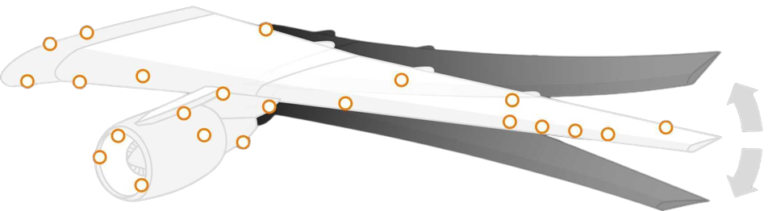
Full-scale component tests generate a lot of measurement data due to the many strain gage sensors used. The fully configurable data loggers offer maximum flexibility for generating fatigue time series data whether you prefer low-frequency continuous logging, triggered high-speed logging, snapshot logging, or peak-valley logging. Up to 20 configurable data loggers run in parallel, and three levels of redundancy with HOT SWAP keep the data available even while a drive is exchanged during the run.
Open Interfaces for Cost-Effective Monitoring of Complex Tests
Predicting or quickly detecting structural failures is important during a complex full-scale component test. Reliable interoperability between load control, data acquisition, and simulation systems are vital for making reporting of test results, including correlation with simulation models, more efficient. GI.connectivity provides safe and reliable data exchange and interoperability through various read/write interfaces, including collaborative solutions for test systems from Moog and MTS.
One Time Base Across the Entire Rig
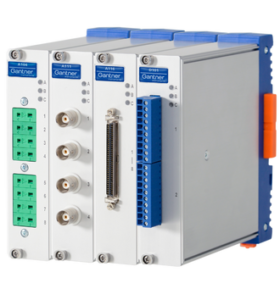
Asynchronous data is one of the largest sources of uncertainty in a test program. Q.series X synchronizes all channels out of the box with a maximum jitter below 100 ns, even when the system is distributed over long distances. Various time protocols are supported to synchronize with a high-precision timekeeping device or ancillary control and measuring systems.
Who trusts Gantner for Aerospace Structural Testing?