


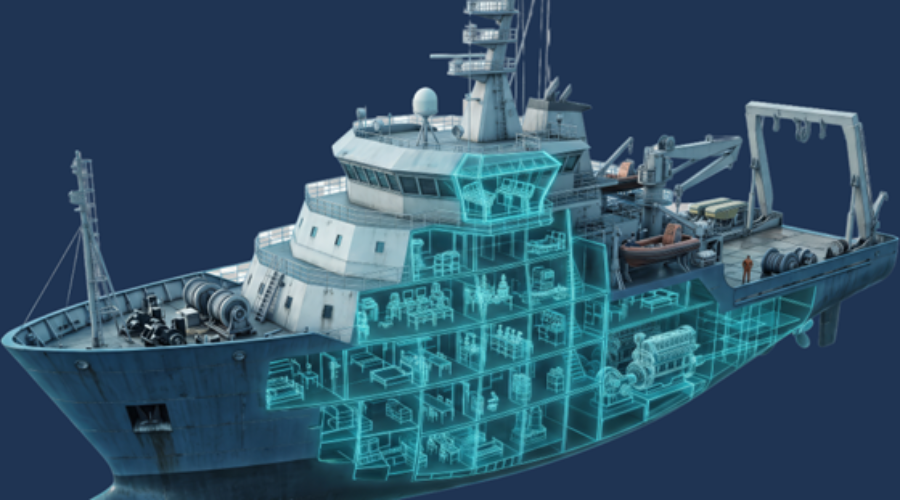
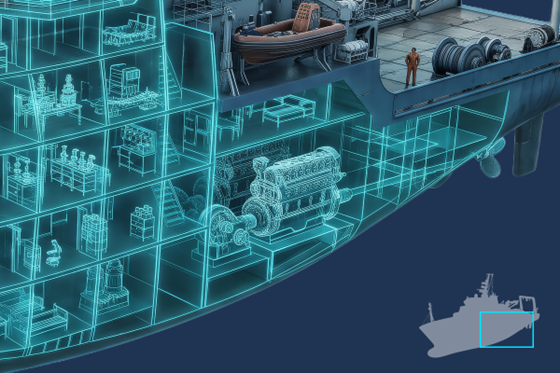
The parts of a modern ship age at different speeds. Digital components — sensors, control systems, software — are replaced on cycles measured in months. Hull, machinery, and shafting are replaced on cycles measured in decades. A ship is a System of Systems: platform, mission system, sensors, effectors, and platform technology, all of which have to stay operational across those mismatched cycles at the same time.
Naval and maritime engineering is working through that problem on several fronts at once: low-voltage DC (LVDC) power systems and battery installations on combat ships, active vibration control for signature, AI-based damage-pattern recognition for maintenance, cyber resilience for onboard systems, and navigation in areas without satellite navigation (GNSS) reception.
Every one of those topics ends at a sensor. Whether a hull, a drivetrain, or a battery room stays relevant depends on whether you can still measure it — reliably, in the same way, and with data you can compare to what you measured five years ago.
Here are five challenges that follow from that, and what each one asks of your measurement chain.
1. The ship outlives its electronics
A frigate’s hull and machinery serve for decades. The electronics that measure them turn over every few years. Each time a data acquisition generation is replaced, three things break at once: the comparability of the data, the training of the people who run it, and the spares you hold for it.
The security situation adds a fourth. When the industrial base has to deliver in a crisis and not only in peacetime, the origin of a measurement chain becomes a supply-chain question, not just a technical one.
What to ask before you specify
Is the module you install today still available in ten years? Does the software need a subscription to keep running? Is the next generation compatible with the last, or does it start a new data set?
Q.series X is built around those questions: upward-compatible product generations, subscription-free software, and lifetime support and calibration. The same measurement performance is available across the bloxx, brixx, and raxx form factors, so a module can move from a test rig into a permanent installation without changing the data it produces. Development and manufacturing are in Europe.
2. Trial data is the baseline for everything after
Sea trials produce the reference state of a ship. Condition-based maintenance measures how far the ship has drifted from that state. If the trial rig and the monitoring installation are two different measurement chains, the comparison between them is a matter of interpretation.
Civil regulation has written this down. The International Maritime Organization’s revised guidelines on underwater radiated noise (URN), in force since October 2023 and amended in 2024, name URN baselining as an explicit planning step. A regulator has put into a guideline what naval test engineers have always known: without a baseline, later data has nothing to be compared against.
One chain, two phases
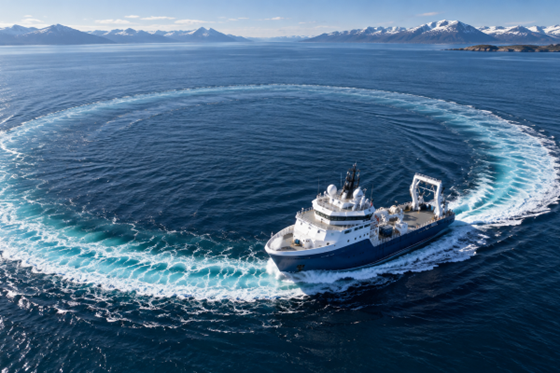
During trials you instrument heavily and temporarily: hundreds of measurement points, a few days at sea, then everything comes off. In service, a subset stays on board for years. If both phases run on the same module family, the permanent installation is the trial rig minus channels — provided the sensors that stay are mounted and calibrated to the same procedure as the ones that leave. One calibration regime. One training. That matters when crews and training have to scale to new units at the same time.
Those points include strain gauges on the hull girder and the foundations, in full, half and quarter bridge, with DC or carrier-frequency excitation on the same module. How the bridge is wired decides what the data is worth years later.
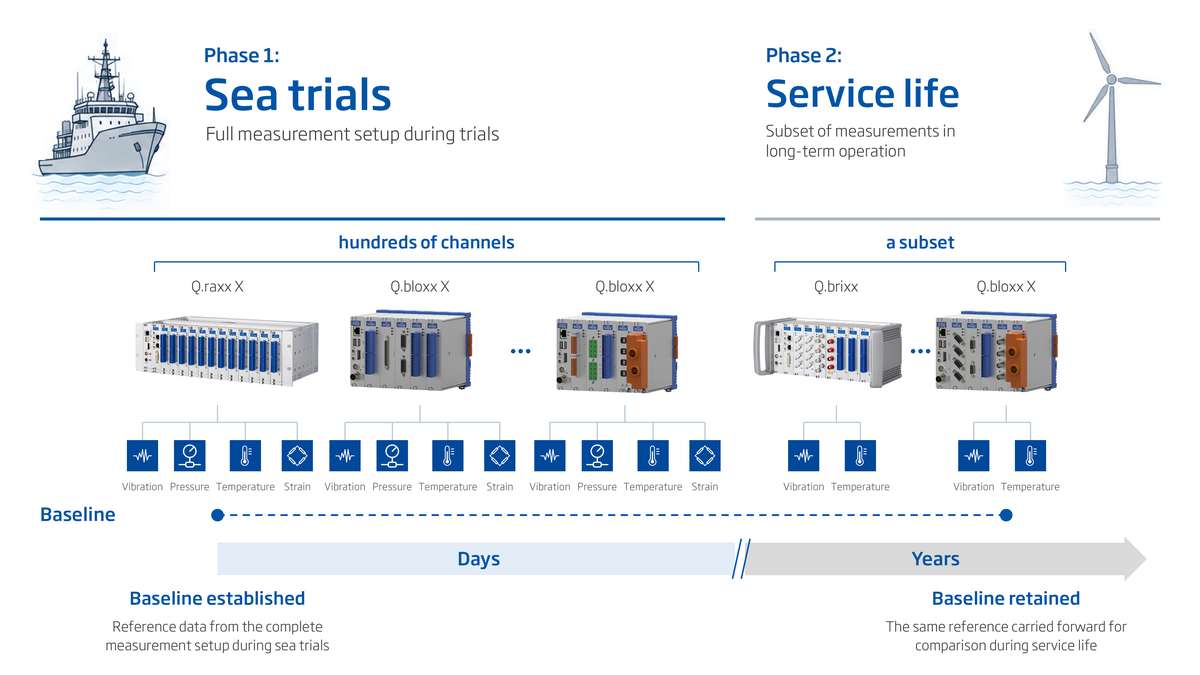
The baseline recorded during those days stays the reference for everything measured afterwards. That only holds if it is the same chain, not a comparable one — otherwise the comparison between the two phases is a matter of interpretation.
3. Measuring on a ship is not measuring in a hall
On a test bench you run two hundred cables into a cabinet. On a ship every one of those cables passes through a bulkhead, and every penetration is a certification item and a hole in watertight integrity. This, not channel count, is why distributed acquisition wins at sea: you put the modules next to the sensors and send data through the bulkhead instead of analog signals.
The practical difference shows up on installation day. A distributed layout means a module in the shaft tunnel, one in the engine room, one at the mast, each a few meters from its sensors, daisy-chained on one bus line that runs from module to module back to the controller, rather than a bundle of sensor cables. Short analog runs also mean less exposure to the electromagnetic environment of a warship, which is not a quiet place. And when the trial is over, what comes off the ship is a handful of modules and one cable, not a harness.
Distributed, but on one timeline
Structure-borne noise at the propeller shaft and the hull response eighty meters away only mean something on the same time axis. Q.series X keeps distributed modules synchronized to a maximum jitter below 100 ns, with up to 64 I/O modules per controller. Every channel on the ship, whatever module it sits in, carries the same time stamp.
The run continues when the network does not
A sea trial does not repeat cheaply. Four days at sea, weather risk, and a ship that has to return to service. The Q.station X controller runs on real-time Linux (RT-Linux) without a PC, with up to 20 independent loggers writing to a ring buffer with automatic drive selection. If the laptop or the network fails, the run continues, and the data are waiting on the controller when the connection comes back.
4. Electrification and signature share one measurement problem
Two of the most active topics in naval engineering look unrelated. They are not.
LVDC power systems and scalable battery systems for combat ships bring high voltage into spaces that used to carry diesel. Civil shipping has the IMO Net-Zero Framework as its driver — approved in April 2025, with formal adoption reconvened for October 2026. Naval electrification has different reasons, signature and endurance among them, but the measurement task is the same: high voltage next to millivolt signals from strain gages and accelerometers, in the same test run.
Q.series X acquires both in one architecture with 1,500 V isolation. One measurement chain, not two that you align afterwards.
Electrical and mechanical power in one device
Propulsion efficiency is a ratio: electrical power in, mechanical power out. The ratio is only as good as the time alignment between the two measurements. The GPA series power analyzer measures both sides in one device — voltage and current at up to 4 MHz per channel for power, efficiency, and harmonics, with torque and speed on the same clock. No second instrument, and no aligning of two time bases after the test.
Signature is a vibration measurement
Active vibration control makes the connection explicit: reduced structural vibration is increased stealth. Vibroacoustic signature is measured as structure-borne noise and vibration and correlated with the operating parameters that cause it — shaft speed, load, power flow. That correlation only works when electrical, mechanical, and acoustic channels sit on one timeline. Which is the same requirement electrification imposes.
Structure-borne noise and hull response run on the same controller as the strain and power channels. Q.bloxx X A111 provides four galvanically isolated analog input channels for IEPE sensors and voltage; Q.bloxx X A107 4M1 takes MEMS-based sensors. Vibration measurement helps in diagnosing potential issues, predicting machinery failure, and ensuring structural integrity — on a ship all three happen on the same hull at the same time.
5. The data does not leave the ship
Since July 2024, the International Association of Classification Societies’ Unified Requirements E26 and E27 (IACS UR E26/E27) apply to commercial ships contracted for construction. E27 addresses onboard systems and equipment, including what third-party suppliers install. Naval programmes are stricter: trial data on a warship is classified from the first sample.
On their side, naval projects are answering with autonomous data infrastructure on board, secure connectivity and edge compute for legacy and new systems alike, and cyber security that is planned at the start of a programme rather than added at the end. What they ask of a measurement supplier comes down to three questions.
AI-based damage-pattern recognition, which naval maintenance is moving towards, needs analysis-ready data with metadata and traceability — not raw streams sorted out afterwards. Q.series X reduces data at the edge and delivers it with the context a model needs.
Since GI.bench V1.19, that model can sit inside the measurement loop through full Model Context Protocol (MCP) access. MCP is an interface, not a cloud service: a model hosted inside your own network keeps the whole loop inside your boundary. The models for anomaly detection run on the hardware itself — on Q.station and on Q.core, the on-board processing unit.
Three questions to ask any measurement system
Where do the data sit? Which jurisdiction does the operator fall under? Does the test run continue when the cloud connection drops?
For Q.series X the answers are: in your network, yours, and yes. The whole measurement chain runs locally. There is no cloud requirement, no subscription that reports home, and the controller does not depend on a PC to keep acquiring. Support and calibration are a service relationship, not a network connection. What you do with the data — analysis in GI.bench, integration through OPC UA, DDS, iDDS, CAN, EtherCAT, or PROFINET, or an API into your own test environment — stays inside the boundary you define.
What the five have in common
A ship is a System of Systems, and that is also the measurement frame. Lifecycle, baseline, distribution, mixed signals, and data sovereignty are five views of one requirement: a measurement chain that produces comparable data over decades, on a ship, under the conditions the ship sets.
So the question at specification time is not which system measures best today, but which one still measures the same way in ten years.
If one of the five is on your desk — structural testing, platform technology, propulsion, electrical systems, system integration, or long-term monitoring — tell us which, and what your measurement chain has to do about it: on the test bench, at sea, and in the years between.
📍 Where to meet us
We discuss these challenges in person at conferences and workshops throughout the year — among them the 28th DWT Marine Workshop in Linstow from September 28 to 30, 2026, where you can book a meeting with a measurement expert, and the Rostock Large Engine Symposium on October 13 and 14, 2026, where future fuels, new engine concepts, and retrofit are on the agenda. All dates and locations are in our event calendar.
More articles
Gantner Instruments Presents Cryogenic Measurement Solutions for Hydrogen Technology
Hydrogen systems are a steadily growing field encompassing several technologies, such as liquefied hydrogen storage tanks, fuel cells, and cryogenic engines. These require meticulous temperature monitoring to ensure system integrity and performance. Operating in these low-temperature environments presents unique challenges, such as thermal contraction of materials, sensor self-heating, and the non-linearity of cryogenic sensors. Without accurate measurement, performance degradation and potential system failures become risks.
Read more...Q.series X A156
New 4-channel carrier frequency amplifier for inductive transducers and strain gages
Read more...TestRig 2026
The TestRig 2026 takes place on March 11–12, 2026, and is an interdisciplinary conference dedicated to the design and operation of modern test benches. It brings together experts from mechanical engineering, electrical engineering, sensor technology, actuators, and control and measurement systems. The focus is on test benches used to analyze vibration behavior, fatigue strength, and the reliability of technical systems.
Read more...Mitutoyo Battery Forum 2026
Meet us at the Mitutoyo Battery Forum 2026 on May 20–21, 2026, in Leonberg.
Read more...