


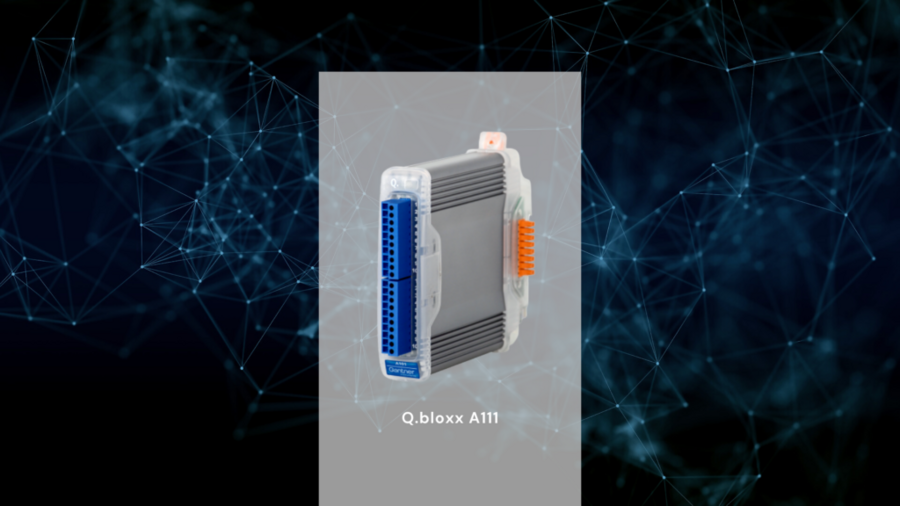
Q.bloxx measurement modules provide integrated signal conditioning and arithmetic functions, packaged in modular, DIN Rail mountable enclosures that easily snap together for quick system expansion.
The Key features:
- 4 galvanic isolated analog input channels
IEPE sensors/voltages - Fast high accuracy digitalization
24 bit ADC, 100 kHz sample rate per channel - Signal conditioning
16 virtual channels, linearization, digital filter, average, scaling, min/max storage, RMS, arithmetic, alarm - RS485 fieldbus interface
up to 48 Mbps: LocalBus up to 115.2 kbps: Modbus-RTU, ASCII - Connectable to any Test Controller
e.g. Q.station, Q.gate, or Q.pac - Galvanic isolation
channel to channel to power supply and to interface Isolation voltage 500 VDC - Electromagnetic Compatibility
according EN 61000-4 and EN 55011 - Power supply 10 to 30 VDC
- DIN rail mounting (EN 60715)
For more information about Q.bloxx A111 Measurement DAQ , click here: IEPE Sensor/Voltage Measurement DAQ A111
More articles
Q.series interface with the Moog Aerospace Test Controller
The amount of data generated in an aircraft structural test program continues to grow. The density of load introduction points (actuators) and sensors (strain gauges, thermocouples, LVDTs) on a test article is increasing progressively and model validation requires higher data sample rates to capture more detail. The risks and costs involved in aircraft validation and certification are significant, and the requirement for quick entry-into-service is high. To minimize the impact of retrofitting in-service aircrafts, the ability to generate test results quickly is crucial to the success of a test program.
Read more...TechDay SHM 2026
This event focuses on Structural Health Monitoring and gives you a great chance to explore the latest technologies and connect with industry experts.
Read more...6 Tips for Stress-free Strain Measurement during Fatigue Testing of Aircraft Structures
Strain is the single most important measurement during aircraft fatigue testing. The accuracy and precision of strain gauge measurements is of the greatest importance to exactly determine the durability and damage tolerance of a structure. The higher a structure is in the ‘pyramid of test’, the higher the test complexity, number of measurement channels, and data produced. On top of that the risk in terms of time delay and cost associated to a test program increases more than proportional with the increase in test complexity. Here are six tips to help you choose the right data acquisition system for your fatigue test:
Read more...Q.series X A142
Universal I/O module with analog output for closed-loop control applications
Read more...