

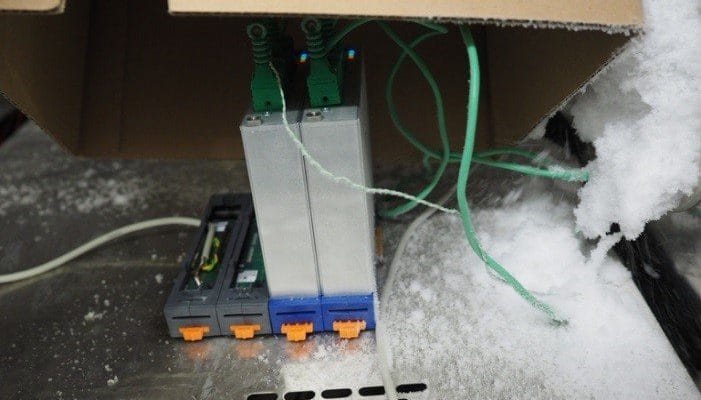
The Q.bloxx XL A104 TCK provides 8 channels for thermocouples (here as Type K, NiCr/Ni) with standard miniature front sockets.
During a day in the climate chamber at -40°C it was completely frozen. After connecting with power supply to the I/O module it was delivering stable and precise measurement values. When temperature was increasing it passed dew point. We observed no impact on the measurement quality or from condensation during this phase. Our I/O module passed this test successfully – even when the datasheet recommends only -20°C operating conditions.
More articles
Sensor Shenzhen 2026
Curious about where the sensor industry is heading next? Discover how rapid innovation, global growth, and cutting-edge measurement technologies are shaping the future at Sensor Shenzhen 2026.
Read more...SUPSI PVLab Industry Days
On November 29 & 30, 2021, a webinar organized by SUPSI will be held on the topic of “Quality of production and production of energy”.
Read more...GI.service Asset performance optimizer
With the significant investments being made in distributed renewable energies, the global energy market is changing from a central supply concept to a decentralized system. This transition is presenting companies in the energy market with various strategic and technical challenges to achieve efficient operations.
Read more...Innovative EIS Solution for Next-Generation Battery Storage Systems
Electrochemical Impedance Spectroscopy (EIS) is an analytical tool for anyone involved in the development, maintenance, and advancement of electrochemical systems like batteries, fuel cells, and electrolyzers. Understanding EIS and its benefits can provide a substantial edge in optimizing these systems’ performance and longevity.
Read more...