

Racing car engines can produce rotational speeds of up to 20,000 rpm. The special challenge in measuring these speeds is the extremely rapid changes in rotation of up to 100,000 rpm per second. It is therefore essential that the index gap in the gearwheel, used for recording purposes, comprises two missing teeth instead of one. A single missing tooth could be confused with a fast decrease in rotational speed.
The D107 module can detect the missing teeth at maximum speeds, and correct each measured value in real time. This contributes to stabilizing the measured speed values, and readings are not influenced by the index gap.
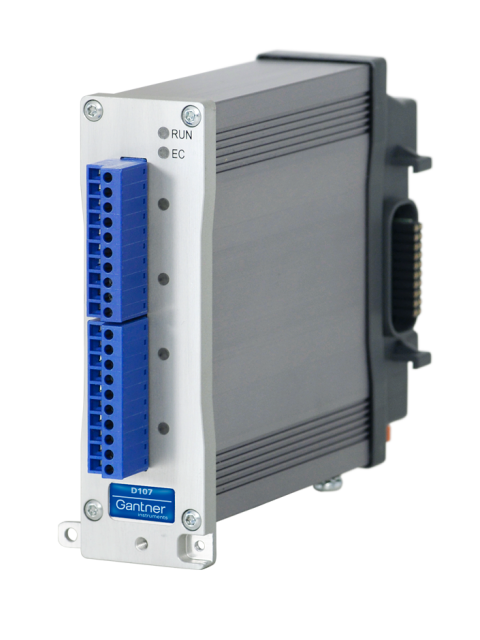
- 2 galvanic isolated input channels, each with3 differential or single-ended inputs.
- Configurable thresholds -20 V to +20 V,therefor usable with inductive sensors witch providingan amplitude that’s depends on the frequency.
- Input frequency range up to 1 MHz, thanks to theused Chronos method frequencies can be measureddown below 1 Hz without a gap.
Dedicated for frequency, PWM and time measurement and for counter signals quadrature counter with reference zero.
The new digital measurement module D107 is available in the known types: For the DIN-rail, as EtherCAT module in Q.brixx desktop case and in the 19 “variants 1U and 3U.
More articles
AEWG General Meeting 2026
Connect with experts in acoustic emission technology and explore practical solutions for today’s measurement challenges in a collaborative environment.
Read more...Integrate Gantner Instruments with NI LabVIEW
The easiest way to connect Gantner DAQ to your LabVIEW environment—now better than ever. Gantner Instruments understands the needs of engineers working across R&D, testing, and industrial automation. That’s why we’ve made it easier than ever to connect our modular, high-precision data acquisition systems, Q.series and Q.series X, with one of the most widely used engineering platforms: NI LabVIEW.
Read more...Bridge Excitation and Measuring Range with Strain Gauge
Strain gauge bridges provide signals that depends on bridge excitation. Therefor the bridge signal is expressed in mV/V (ratiometric measurement).
Read more...SUPSI PVLab Industry Days
On November 29 & 30, 2021, a webinar organized by SUPSI will be held on the topic of “Quality of production and production of energy”.
Read more...