
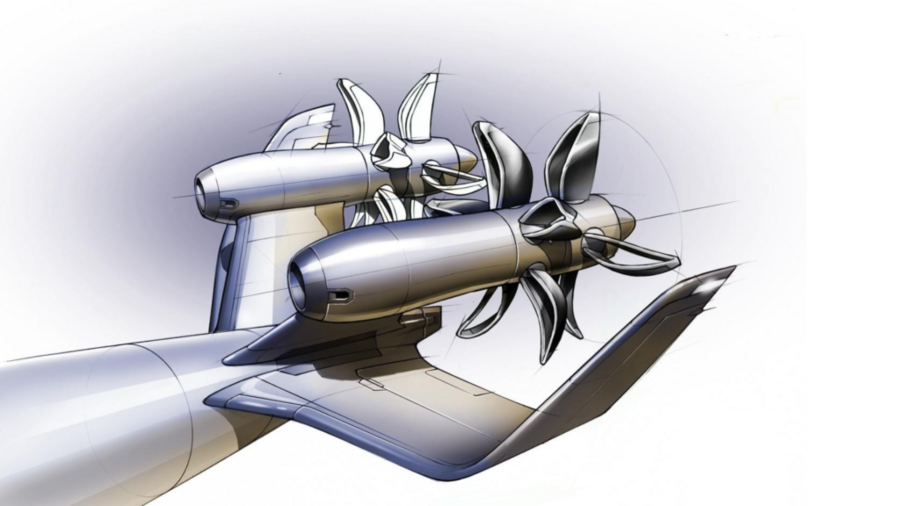
The Open Rotor engine project is part of the Clean Sky* Sustainable and Green Engines (SAGE) programme, a 50% European Union-funded, multi-partner activity aimed at lowering fuel consumption and emissions through more efficient aero engine architectures.
The data acquisition system can record, display and process up to 1000 different parameters, varying from pressures, flow rates, frequencies and temperatures. The flexible system concept allows for mixing Q.raxx and Q.staxx modules, depending on where they are installed inside the test cell.
Great to see how the full-scale Geared Pusher Open Rotor is tested at Safran Aircraft Engine’s new open air test facility:
* Clean Sky is the most ambitious aeronautical research programme ever launched in Europe. Its mission is to develop breakthrough technologies to significantly increase the environmental performances of airplanes and air transport, resulting in less noisy and more fuel-efficient aircraft, hence bringing a key contribution in achieving the Single European Sky environmental objectives.
More articles
Q.series X A107 SV: Universal Measurement Module with Sensor Supply
Gantner Instruments' Q.series X A107 4 x Lemo 2B SV module is an adaptable and precise universal measurement module designed for engineers who need accurate data acquisition in distributed installations. This module, which is part of the modular and scalable Q.series X product family, now includes programmable sensor supply voltage and current limit capabilities per channel.
Read more...Gantner Instruments Helps Flood Victims in the Philippines
Yet another terrible natural disaster has left its mark. In the Philippines, the typhoon Hayian has cost the lives of countless people. Gantner Instruments made a donation to support reconstruction.
Read more...How to keep up when measuring the Evolution of battery technology
As a professional in battery development, it is essential to perform cycling and stress testing before installing batteries in electric vehicles (EVs) or other products. Testing and monitoring help ensure functionality, reliability, safety, quality, cost, efficiency, and power quality.
Read more...Streamlining Data Acquisition at CERN with Blinky-Lite and Gantner Instruments
Safe, secure, and traceable data acquisition is essential in complex, large-scale scientific environments like the European Organization for Nuclear Research (CERN). Reliable remote access is critical to supporting the diverse team members in their data acquisition (DAQ) setup and operations. Collaborating with the Blinky-lite team, we have implemented a test setup that successfully navigates these challenges in constrained environments.
Read more...