



Unlocking the Full Potential of Batteries and Hydrogen Technologies
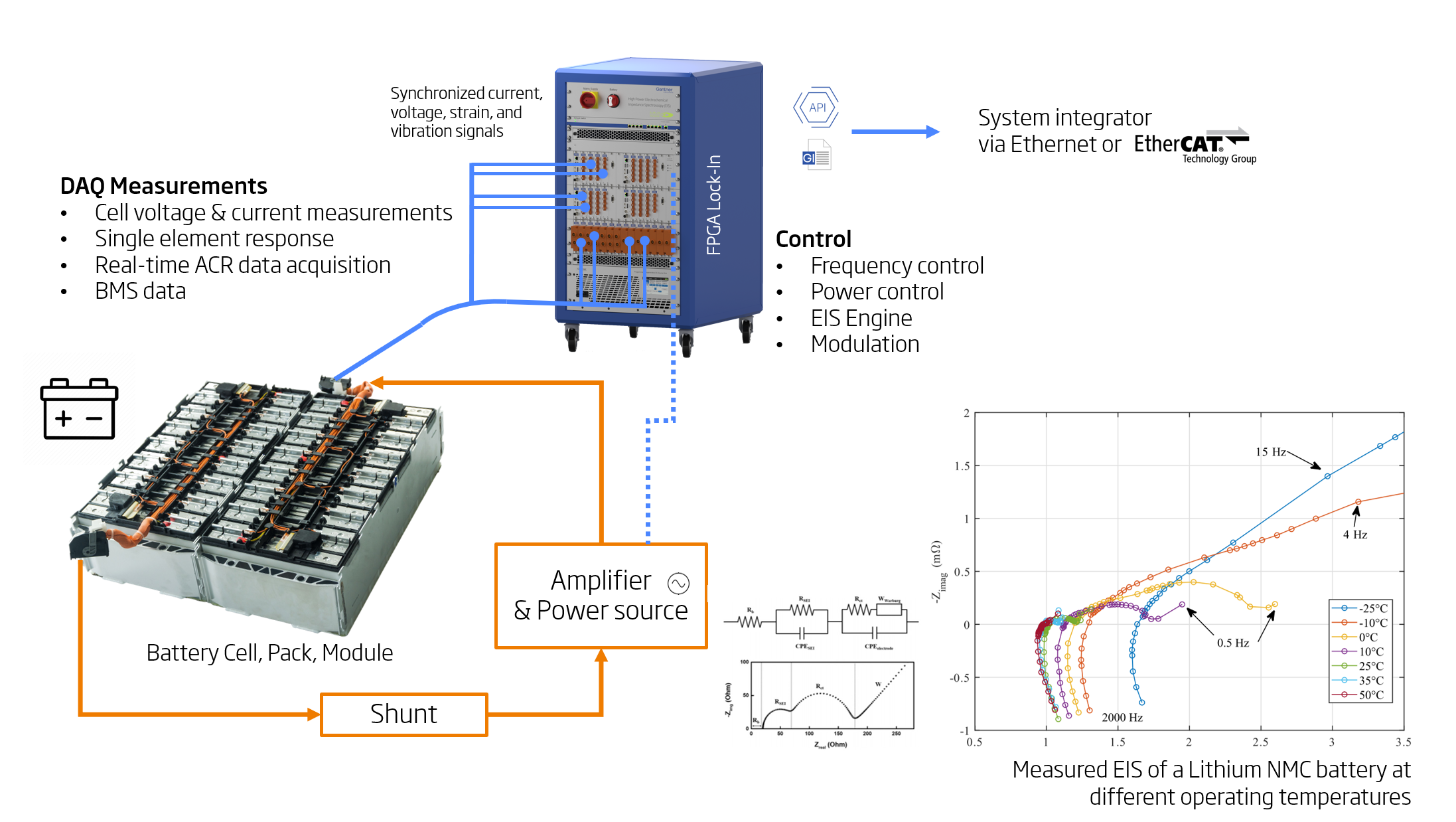
Principle of EIS
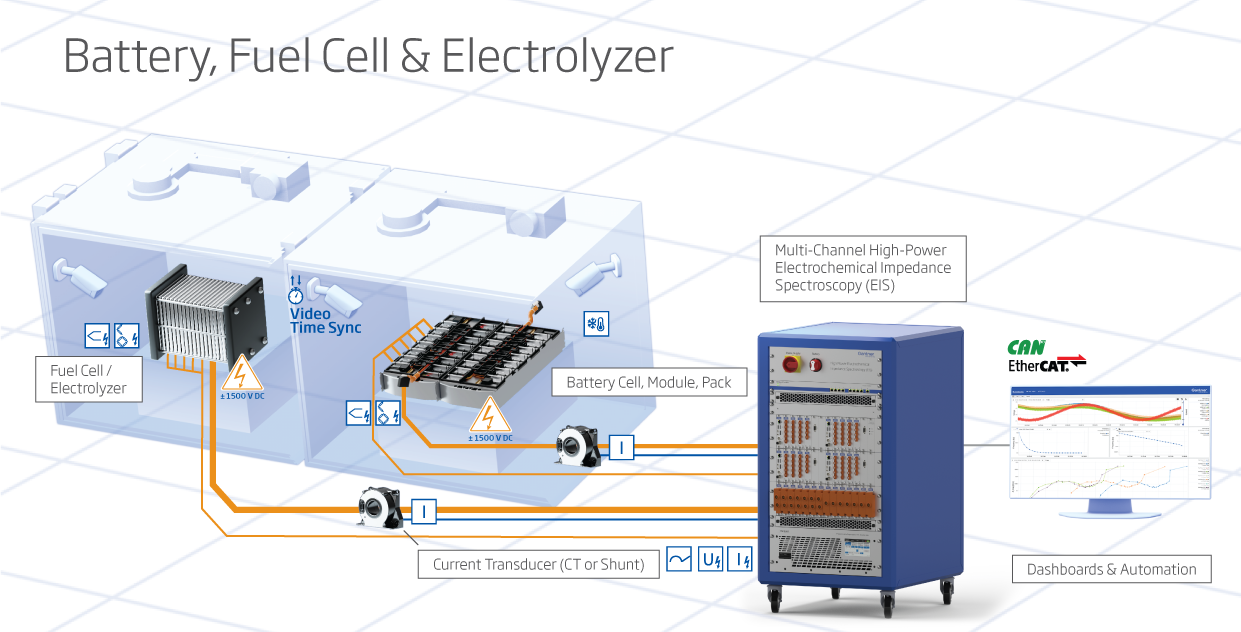
Electrochemical Impedance Spectroscopy involves applying an alternating current (AC) voltage signal to an electrochemical system, such as a battery or an electrolyzer/fuel cell, and measuring the resulting current response over a range of frequencies. This analysis of the frequency-dependent response reveals the chemical and physical processes within the system, providing complex impedance plots that help extract information about the system’s properties and behavior.
EIS Benefits
EIS is a non-destructive technique bridging the gap between steady-state and transient-state electrochemical studies. It enables researchers to investigate electrode kinetics during discharge or recharge stages. This information improves the understanding and control of chemical processes in energy storage devices, enhancing performance, efficiency, and durability. EIS can identify issues related to material layers, charge transfer, diffusion effects, and electrolyte conductivity, optimizing the design, materials, and manufacturing processes of batteries and hydrogen technologies, leading to improved performance and lower costs.
Batteries and Hydrogen Technologies
EIS applies to a wide range of electrochemical systems, including batteries and hydrogen technologies like fuel cells and electrolyzers. In batteries, EIS studies electrode reaction kinetics, monitors internal resistance and capacitance changes, and detects capacity fade and degradation mechanisms. This helps optimize battery performance, lifespan, and safety, leading to more efficient and durable energy storage solutions. In hydrogen technologies, EIS provides insights into hydrogen production and storage processes. It studies water-splitting reactions in electrolyzers, monitors fuel cell electrode performance, and detects changes in hydrogen storage materials. This aids in developing efficient, cost-effective, and sustainable hydrogen technologies.
Challenges and GI Benefits
EIS requires specialized instrumentation and can be time-consuming and computationally intensive. Achieving a balance between measurement speed, accuracy, and cost is a key challenge in the design and implementation of EIS systems. Gantner Instruments addresses these challenges with its innovative all-in-one EIS data acquisition and analysis solution, providing efficient, cost-effective, and accurate insights to unlock the full potential of batteries and hydrogen technologies.
Integration with Q.series X
Integrate EIS seamlessly with the Q.series X data acquisition system, providing a comprehensive solution for monitoring and analyzing electrochemical systems. The Q.series X offers high-speed data acquisition, modular expandability, and integration with existing infrastructure, making it an ideal platform for EIS studies.
Gantner Instruments’ all-in-one EIS solution exceeds all standard requirements of electrochemical impedance spectroscopy through its robust design and advanced technical features. The system includes a high-performance Q.series X A193 module, designed for high-power and industrial applications, with capabilities for signal amplification and offset measurement that enhance sensitivity and selectivity in impedance measurements. The voltage measurement range and current measurement flexibility, supported by robust galvanic isolation, ensure accurate and reliable data collection across various applications, including entire battery packs. Synchronous signal collection maintains data coherence and accuracy, utilizing the Lock-In technique to isolate specific signal frequencies and phases, essential for detecting weak signals in noisy environments. The system’s broad frequency range from 1 mHz to 10 kHz and modular configuration, scalable up to 128 EIS channels, make it suitable for diverse electrochemical testing requirements. Comprehensive data accessibility and real-time visualization tools, including Nyquist and Bode plots, facilitate detailed analysis and immediate feedback. Advanced connectivity options, such as an open API and EtherCAT interface, ensure seamless integration with existing power systems and automation setups. Additional features like high-isolation thermocouple inputs, temperature measurement channels, and an air deflector for heat management further enhance system performance and reliability, making Gantner’s EIS solution a comprehensive and efficient tool for optimizing batteries, fuel cells, and electrolyzers.
Unlock the Potential of Next-Gen Battery Storage with Advanced EIS
Explore how Gantner Instruments’ cutting-edge Electrochemical Impedance Spectroscopy (EIS) solutions help maximize performance, enhance longevity, and deliver unparalleled insights for next-generation battery storage technologies.
More articles
TestRig 2026
The TestRig 2026 takes place on March 11–12, 2026, and is an interdisciplinary conference dedicated to the design and operation of modern test benches. It brings together experts from mechanical engineering, electrical engineering, sensor technology, actuators, and control and measurement systems. The focus is on test benches used to analyze vibration behavior, fatigue strength, and the reliability of technical systems.
Read more...High Performance Measuring Module D107 for Frequencies
The Q.bloxx D107 is a new measurement module for the acquisition of frequencies and incremental signals. Due to its fast signal conditioning capability with a clock speed of 288 MHz, the new module is suitable for extreme measurement of rotational speeds, which were not previously possible in this price range.
Read more...New Monitoring Solution – Q.series Portable
For short-term or rout-based condition monitoring of various assets we now provide a portable system solution. Our new Q.series Portable based on Q.station 101 and OEM-boards for analog and digital inputs contained in a robust transport case is fully engineered and ready to use ‘out of the box’. The electronic boards and the power supply system are mounted on shock absorbers to withstand heavy-duty work under harsh environments in the field.
Read more...GI.service Asset performance optimizer
With the significant investments being made in distributed renewable energies, the global energy market is changing from a central supply concept to a decentralized system. This transition is presenting companies in the energy market with various strategic and technical challenges to achieve efficient operations.
Read more...