
Inductive transducers play an essential role in today’s world. The transducers are used for the measurement of positions, displacement, rotation, vibration, and material thickness. In test and measurement applications and frequently in the field of structural health monitoring of civil infrastructure, power plants, or condition monitoring in the process industry.
Inductive displacement transducers are a proven, reliable measurement option for detecting displacements and positions. They are characterized by contactless and thus extremely low-wear detection with a high possible measurement dynamic. If high-quality materials are used, extraordinary robustness is achieved, which allows maintenance-free operation for decades. With inductive displacement transducers, high-precision measurements can be carried out under dirty or harsh environmental conditions.
Q.series X A156
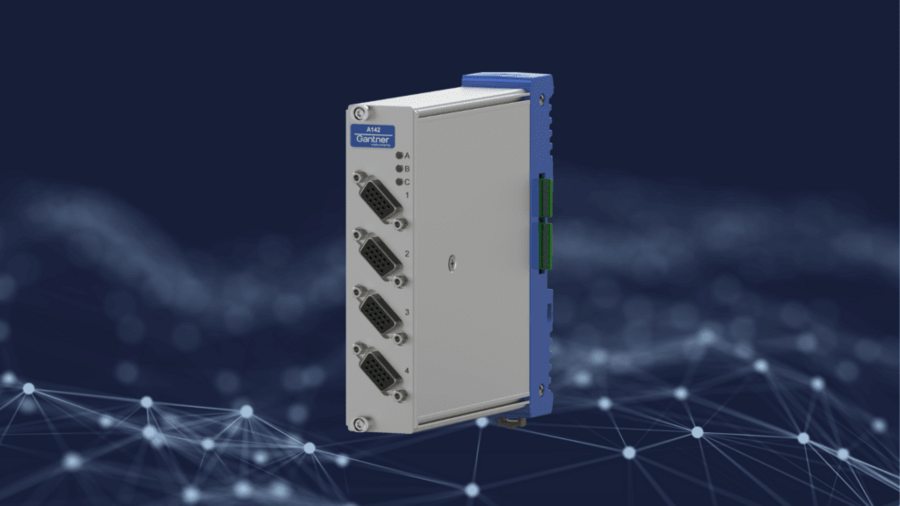
We developed the new 4-channel carrier frequency amplifier, A156, for measuring strain gages and, especially, inductive transducers. the module is based on our renowned ed A106 carrier frequency amplifier, which has been proven for years. In contrast to the A106, the A156 has four channels but does without the analog outputs.
The A156 excites the transducers with a 4.8 kHz AC voltage, the so-called carrier frequency (abbreviated CF). The amplitude is software selectable, either 2.5 V or 5 V. The module offers 16 measurement ranges and a sample rate of 20 kHz per channel with a 24-bit resolution. Adjustable digital filters allow further optimization of the measurement data according to the application’s needs.
The module is available with the front screw terminals or SubD sockets in the DSUB9 and DSUB15-HD versions. It thus offers all necessary connection options for modernizing your existing measurement setup.
Main features:
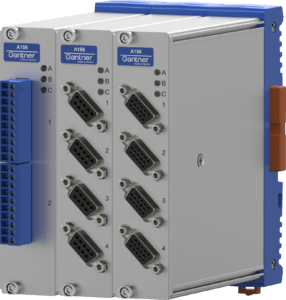
- Four galvanically isolated input channels for inductive transducers and strain gages
- Carrier frequency technology with 4.8 kHz AC excitation and software selectable amplitude 2.5 V or 5 V (per channel)
- 16 measuring ranges from 1.25 mV/V to 1000 mV/V
- 20 kHz measuring rate per channel with 24-bit resolution
- 500 V isolation voltage channel to channel, channel to power supply, and channel to bus
Why inductive transducers?
Inductive transducers (also known as passive transducers) are used primarily in experimental environments or under challenging environmental conditions (temperature, radiation, EMC) since they can be flexibly adapted to the respective measurement task. With an external, flexible measuring amplifier such as the A156 module, transducers can also be optimally used below the nominal measuring range due to different measuring ranges. In the case of active transducers, however, the range of application is limited to the nominal measuring path due to integrated electronics, so this type of transducer is more likely to be found in the industrial sector and normal ambient conditions.
How inductive displacement transducers work
The inductive measuring principle is based on the change of a coil’s behavior (inductance) by the change of position of a magnetizable core inside the coil. There are two wiring types for the coils:
- Coil with center tap (differential inductor)
- Configuration of electrically separated primary and secondary coils
Advantages of a carrier frequency amplifier
The coils of inductive displacement transducers require an AC voltage to generate the magnetic field. This is where the carrier frequency comes into play – an AC excitation voltage with a typical frequency of 4.8 kHz. The transducer modulates the amplitude of this AC excitation voltage.
The transducer modulates the amplitude of this AC excitation voltage. This transducer signal is isolated from the carrier signal in the measuring amplifier and processed through a demodulation process.
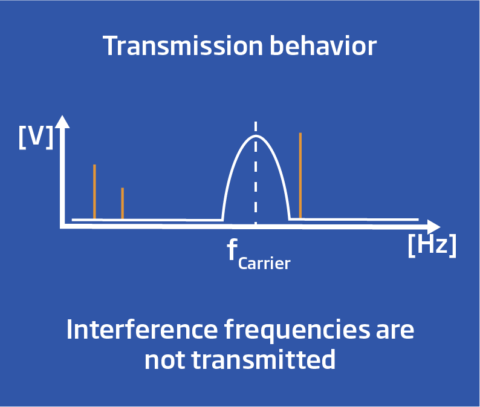
Since only modulated signals, i.e. a narrow band of the signal frequency, are transmitted, this results in significantly lower sensitivity to interference. Carrier frequency amplifiers transmit selectively, providing much better data in terms of stability, noise, and drift. Carrier frequency amplifiers are versatile: strain gages and strain gage transducers, inductive bridges, LVDTs, RVDTs, capacitance or inductance-based strain gages, and piezo-resistive sensors can be connected.
Learn in one of our following articles how a 2-point scaling can easily calibrate a variety of sensors.
More articles
Sella Controls Ltd appointed as System integration partner of Gantner Instruments GmbH
Gantner Instruments GmbH is very pleased to announce that Sella Controls Ltd has been appointed as a System Integration partner for Gantner Instruments’ test, measurement and data acquisition products and solutions.
Read more...Metro de Madrid Stays Ahead of Brake Problems
METRO DE MADRID is a railway company that provides public transportation services to Madrid and its metropolitan area. Currently, it is the most extensive metro network in Spain, with a length of 294 kilometers. With 302 stations, it is the third-largest network in Europe by kilometers, after those in London and Moscow. It has 2400 trains and makes an average of 650 million trips a year, with 350 million passengers.
Read more...Q.series X D107 SV: Digital Measurement Module with Sensor Supply
The Q.series X D107 2 x Lemo 2B SV module from Gantner Instruments provides a comprehensive solution for digital signal acquisition and sensor supply needs. Designed for distributed installations requiring precise digital measurements, this module enhances the Q.series product family's robust offering.
Read more...Boeing 777X folding wingtip
Boeing is looking to debut a new and ambitious aircraft in 2020: the 777X, a dual-aisle, twin-engine aircraft that is built around fuel efficiency. The aircraft is designed to use 12% less fuel than any competing aircraft and 20% less fuel than today’s 777.
Read more...