

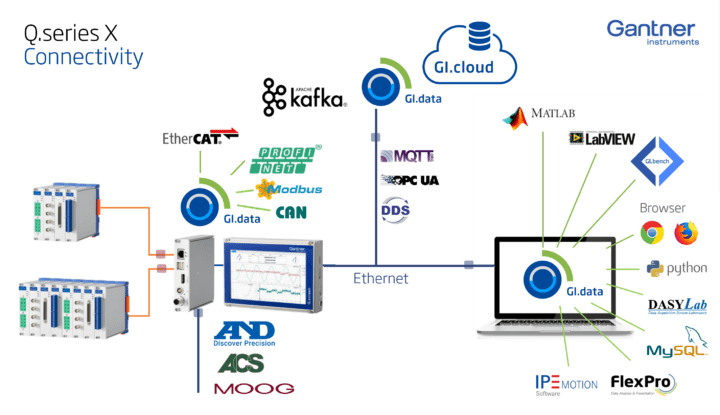
On Thursday, April 30th at 2:00pm ET, our partner FLW Southeast will be hosting a 30 minute webinar presented by Joseph Daniels and Bernhard G. Gruber of Gantner Instruments. Both will cover the key items that engineers should consider when evaluating new DAQ systems – from signal conditioning and I/O distribution to multi-party configuration to real-time monitoring and Cloud storage capabilities. Joseph will also review Gantner’s new Q.series X system and how it can meet these challenges as well as position engineers for future expansion and new technologies implementation

Event
Top Considerations for Selecting a Data Acquisition System for Testing Application
Webinar
April 30, 2020
More articles
Force monitoring improves efficiency of Airbus’ Final Assembly Line
In November 2016 the Airbus A350-1000 flew for the very first time. The A350-1000 is part of the A350 XWB family and is Airbus’ largest and most powerful twin-engined airliner ever. Airbus began the assembly of the A350-1000 in September, 2015, less than a year after the first delivery of the A350-900. For maximum flexibility, the existing A350 XWB Final Assembly Line (FAL) can be used for both A350-900 and A350-1000 models.
Read more...Gantner Instruments appoints Bienfait as new Business Partner in the Netherlands
Gantner Instruments is pleased to announce that is has appointed Bienfait B.V. as business partner in the Netherlands. Bienfait will support Gantner Instruments’ entire portfolio of test and measurement solutions. The appointment provides stronger local support for the country’s rapid growth in key sectors like high-tech systems, energy, water and advanced composite materials.
Read more...TestRig Symposium
The two-day TestRig symposium presents the current state of the art, future-oriented developments and outstanding case studies in the field of test rig construction and operation, and promotes the personal exchange of experience. The symposium will be complemented by an accompanying exhibition.
Read more...Turbomeca Chooses the Q.series
Turbomeca is a french manufacturer of compressors and turbines for the aviation industry, among its customers Eurocopter, Augusta und Sikorsky. For the test and measurement design of future test stands were the products from four manufacturers tested, and the companies rated on quality in production, and in all functional processes. Turbomeca selects Gantner Instruments GmbH as manufacturer and accredited according to strict rules. Gantner Instruments is exclusively represented by BGP Electronic in France.
Read more...