
NOV (National Oilwell Vacro) is a global company in the fields of drilling and conveying technology. NOV supports the world’s most advanced drilling solutions in the oil and gas industry.
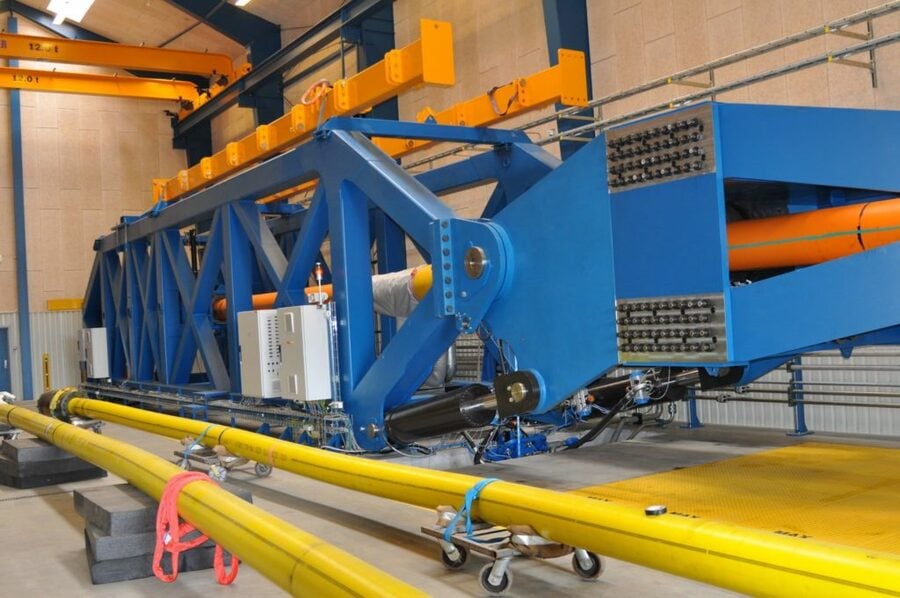
Here almost 150 measuring channels are used in a test system:
- 10 x IEPE with 5 x Q.bloxx A101
- 24 x current with 3 x Q.bloxx A108
- 12 x Pt100 with 3 x Q.bloxx A107
- 96 x SG with 12 x Q.bloxx A116
- Multiple digital I/Os
The measured data is recorded at a sample rate of 10 kHz. A data logger was configured in the Q.station test controller that records the conditioned and raw data. The recorded data is transferred to a SQL database using the test.node server software.
At present, four test systems are being built; with additional systems being planned. Testing is performed in cooperation with our Danish partner IPC Teknik ApS.
More articles
Automotive Testing Expo Novi 2025
Visit us at Booth 8060 from October 21 to 23, 2025, at Automotive Testing Expo North America, Novi, MI.
Read more...Monitoring Porto’s New 400-Meter Metro Bridge
Porto is expanding its metro network, and a key challenge was building a new Douro River crossing that enhances mobility without disrupting the city’s iconic bridge landscape. The result is Ponte Ferreirinha, a slender concrete frame bridge carrying metro trains, cyclists, and pedestrians, blending seamlessly into a dense urban environment.
Read more...Q.series interface with the Moog Aerospace Test Controller
The amount of data generated in an aircraft structural test program continues to grow. The density of load introduction points (actuators) and sensors (strain gauges, thermocouples, LVDTs) on a test article is increasing progressively and model validation requires higher data sample rates to capture more detail. The risks and costs involved in aircraft validation and certification are significant, and the requirement for quick entry-into-service is high. To minimize the impact of retrofitting in-service aircrafts, the ability to generate test results quickly is crucial to the success of a test program.
Read more...Gantner Instruments presents new Machine Learning and Fault detection routines at leading PV and Energy conference in Brussels, Belgium
Within the EU founded project “IPERMON” (“Innovative Performance Monitoring System for Improved Reliability and Optimized Levelized Cost of Electricity”) Gantner Instruments was developing different fault detection routines and failure classification methods for time series data sets.
Read more...