



A Bridge Engineering Masterpiece
Spanning the Tagus River, the 25 de Abril Bridge links Lisbon with Almada. Opened in 1966, this iconic suspension bridge extends 2.3 kilometres, with a main span of 1,013 metres and two side spans of 483 metres each. A stiffening truss carries six lanes of road traffic on the upper deck and two railway lines on the lower level. The rigid beam design is suspended by 1,344 vertical hangers and supported by four main cables. Often compared to the Golden Gate Bridge due to its connection with the American Bridge Company, it is a clear example of infrastructure where reliability, safety, and long-term performance are essential.

The Need for Structural Health Monitoring
As traffic volumes increased and the bridge underwent major upgrades, the structural demands on the 25 de Abril Bridge rose significantly, making advanced structural health monitoring essential. The 1999 expansion added extra road lanes and a rail deck, placing the structure in a new operating regime. To address this, a continuous monitoring system was introduced to closely track structural behaviour. This permanent SHM system has been in operation for over two decades, providing real-time, high-quality data and enabling engineers to actively safeguard the bridge’s performance, safety, and long-term durability.
Reliable, decentralised DAQ for long-term Structural Monitoring
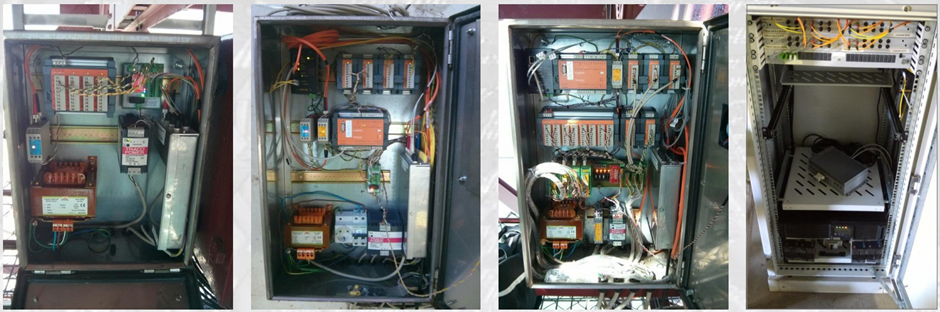
The SHM system was originally built on Gantner Instruments’ e.bloxx data acquisition (DAQ) platform, designed for long-term structural monitoring of critical infrastructure. A network of 210 sensors is connected to 13 synchronised, decentralised DAQ sub-systems distributed across the bridge. This decentralised measurement approach places signal conditioning close to the sensors, minimising analogue cabling and ensuring high data quality. The system supports multi-frequency data acquisition, combining strain gauges, MEMS accelerometers, inclinometers, displacement sensors and temperature sensors to capture both static and dynamic behaviour. Fibre optic communication and GPS time synchronisation ensure accurate, high-resolution data across the entire structure.
Future-Proof SHM with Q.bloxx Upgrade
Over more than 20 years of continuous operation, the system has proven its reliability in long-term bridge monitoring. It enables early detection of structural changes, supports predictive maintenance strategies and helps asset owners reduce lifecycle costs while improving safety. This successful deployment demonstrates how robust DAQ systems are essential for effective structural health monitoring of bridges and other critical infrastructure.
To ensure future readiness, the system is now being upgraded to Gantner Instruments’ Q.bloxx data acquisition platform. This upgrade follows a backward-compatible design strategy, allowing existing SHM systems to evolve without disruption while integrating advanced data processing, higher performance and enhanced scalability. With this transition, the 25 de Abril Bridge continues to set a benchmark in long-term structural health monitoring, providing civil engineers and asset owners with a proven solution for maintaining the safety, reliability and performance of complex infrastructure over decades.
Designed for autonomous operation, the system functions as a standalone DAQ with automatic power-on capability, operating independently of a PC while managing all critical tasks, including data processing, local storage, and buffering, to guarantee continuous, reliable monitoring throughout the construction process.

More articles
Gantner Instruments Presents Cryogenic Measurement Solutions for Hydrogen Technology
Hydrogen systems are a steadily growing field encompassing several technologies, such as liquefied hydrogen storage tanks, fuel cells, and cryogenic engines. These require meticulous temperature monitoring to ensure system integrity and performance. Operating in these low-temperature environments presents unique challenges, such as thermal contraction of materials, sensor self-heating, and the non-linearity of cryogenic sensors. Without accurate measurement, performance degradation and potential system failures become risks.
Read more...Gantner Instruments presents cryogenic measurement solution at Space Tech Expo
From October 24 -26 the Space Tech Expo and Conference took place in Bremen, Germany. The Space Tech is Europe’s meeting place for space business, Technology and innovation.
Read more...Experience a New Level of Possibilities With Our New Website!
We are thrilled to announce the launch of the new Gantner Instrumentswebsite and introduce you to a few of its features.Here’s a sneak peek of what you can expect to […]
Read more...Q.series X D107 SV: Digital Measurement Module with Sensor Supply
The Q.series X D107 SV module from Gantner Instruments provides a comprehensive solution for digital signal acquisition and sensor supply needs. Designed for distributed installations requiring precise digital measurements, this module enhances the Q.series product family's robust offering.
Read more...