



At the center of this challenge is a practical question: how can used batteries be assessed safely, repeatably, and without accelerating aging?
For second-life batteries to become reliable assets in stationary storage, charging infrastructure, backup power systems, and grid applications, their condition must be assessed before reuse. This is where high-power, multichannel Electrochemical Impedance Spectroscopy (EIS) provides critical insight.
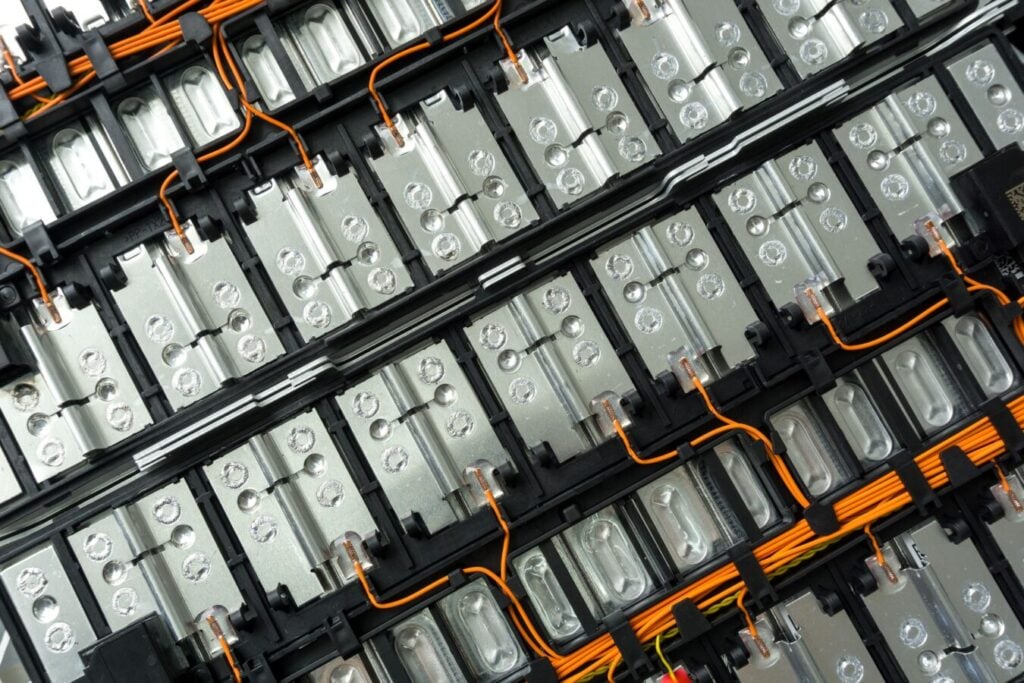
From Used Battery to Trusted Energy Asset
Batteries that reach the end of their first life are not necessarily waste. Many still have sufficient capacity to support demanding second-life applications. Their economic value, however, depends on more than just remaining capacity.
A second-life battery must be safe, predictable, and suitable for its next operating environment. Hidden degradation, thermal stress, changes in internal resistance, and cell imbalance can all affect performance and safety. These effects often develop gradually and may not be visible through basic voltage or capacity checks.
Reliable reuse, therefore, requires measurement-based battery characterization. Engineers need methods that can detect early signs of aging and degradation without damaging the battery or accelerating the very processes they are trying to understand.
IEP’s Role in the NGS Battery Ecosystem
Within the NGS project, Instituto Electrotecnico Portugues (IEP) is establishing a national service for testing and validating second-life batteries. The objective is to support battery health assessment, safety evaluation, and remaining lifetime estimation through robust and repeatable measurement methods.
This work supports a broader national effort to strengthen Portugal’s battery value chain. NGS connects activities across lithium processing, battery components, packs, grid integration, recycling, and end-of-life management. Second-life battery validation is a key part of that circular approach because it helps determine whether batteries should be reused, repurposed, or recycled.
To meet these requirements, IEP selected Gantner Instruments’ partner PerfectDecibel to deliver a high-power, multichannel EIS system for advanced battery testing.
What EIS Reveals About Battery Health
Electrochemical Impedance Spectroscopy (EIS) provides a non-destructive view into a battery’s internal electrical behavior. By applying a small excitation signal and measuring the response, engineers can identify changes linked to ageing, degradation, temperature effects, and remaining suitability for reuse.
Unlike destructive analysis or aggressive stress testing, EIS can help evaluate battery condition while preserving the battery for future operation. This makes it especially valuable for second-life applications, where the goal is not only to understand the battery, but also to keep it usable.
EIS helps turn battery health assessment from an assumption into a measured decision. It supports comparison between modules, identification of abnormal behavior, and earlier detection of changes that may later lead to capacity loss, safety risks, or unplanned downtime.
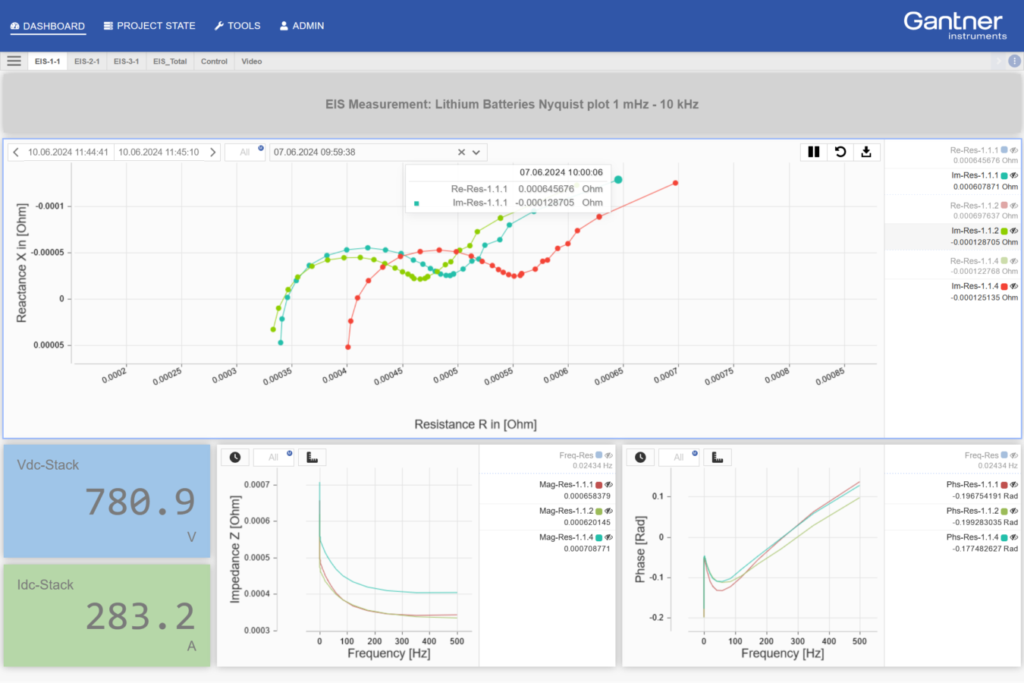
High-Power, Multichannel EIS in Practice
IEP’s EIS system from Gantner Instruments is designed for realistic high-power battery testing. It supports measurements of up to 1000 V and 54 A, enabling battery modules to be assessed under conditions that are closer to real applications than isolated low-power laboratory tests.
The system monitors electrical response and temperature simultaneously across up to 24 cells in parallel. It supports both potentiostatic and galvanostatic measurement modes, giving test engineers the flexibility to investigate battery behavior from different diagnostic perspectives.
This combined electrical and thermal insight provides a clearer real-time picture of battery state of health, thermal stress, and electrical degradation at module level. For second-life batteries, that module-level perspective is essential. Reuse decisions are rarely made on single cells alone; they depend on how complete battery assemblies behave in practical operating conditions.
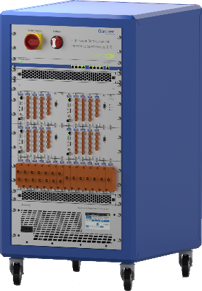
From Measurement to Confident Reuse
High-power, multichannel EIS gives IEP a foundation for repeatable quality assurance and safety assessment. By detecting subtle ageing effects early, the system supports better lifecycle decisions and helps reduce the risk of hidden degradation entering second-life applications.
For the wider energy-storage market, this type of measurement capability is important because second-life batteries must be trusted before they can be deployed at scale. Stationary storage, fast charging, industrial energy systems, backup power, and energy communities all depend on batteries that are safe, predictable, and economically viable.
Within Portugal’s emerging battery ecosystem, IEP’s testing and validation capability helps connect circular-economy ambition with practical engineering evidence. It supports confident decisions on reuse, repurposing, and recycling, and contributes to safer, more sustainable battery deployment.
Enabling a Circular Battery Future
The transition to cleaner energy requires more than new batteries. It also requires better ways to understand, reuse, and recover the batteries already in circulation.
Second-life batteries can reduce waste, extend material value, and support the growth of renewable energy infrastructure. But they can only become dependable energy assets when their condition is measurable, comparable, and trusted.
With high-power, multichannel EIS from Gantner Instruments, IEP is building the measurement foundation needed for safer second-life battery validation and a more circular energy-storage value chain.
Enable safe and economically viable second-life batteries with measurement-based insight.
Learn how high-power, multichannel Electrochemical Impedance Spectroscopy from Gantner Instruments helps assess battery health, detect early degradation, and support confident reuse decisions.
More articles
Symposium on International Automotive Technology
The Symposium on International Automotive Technology (SIAT 2026) returns to Pune from January 28–30, bringing together engineers, researchers, and technical leaders shaping the future of safe, sustainable mobility.
Read more...9 Vital Aspects of Bulletproof Test Cell Systems Integration
You don’t need to design a new DAQ system from scratch. Instead, you can integrate more advanced testing and technology concepts into your existing interfaces and legacy systems – sustainable and cost-effective!
Read more...Q.series X A156
New 4-channel carrier frequency amplifier for inductive transducers and strain gages
Read more...ICCC iCampus Cottbus Conference
Save the Date: iCampus Cottbus Conference (iCCC 2026), May 5–7 at the Radisson Blu Conference Hotel Cottbus!
Read more...