

Gantner Instruments is launching a brand new Optical Gage Amplifier that offers all the benefits of fiber optic measurement, but without the hassle!
What is the F108?
The new F108 Optical Gage Amplifier combines unique fiber optic sensor technology with the modularity and versatility of the Q.series X product line. For quick and easy setup you can use GI.bench and even combine it with GI.cloud for cloud-based storage and monitoring.
The Q.series X F108 is designed for fiber optic π-phase-shifted Bragg grating (πFBG) for high resolution measurement. A laser with a narrow tuning range (~4 nm, nominally ~1548-1552 nm) is used to lock to the dip seen in a πFBG and to track that point as the sensor is subjected to changes in temperature or strain. Or in other words, smaller signal peaks can be measured and that is what makes the measurement more accurate and precise.
What do you have to do to use the unique optical sensor technology for your tasks in DAQ projects? You simply have to plug in… and you can start to measure!
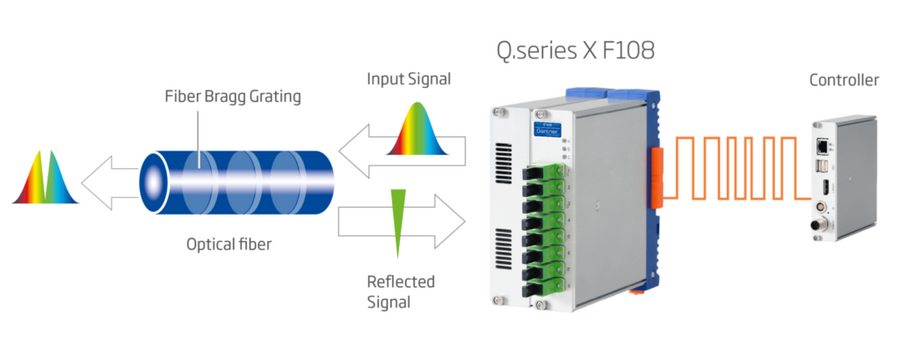
We at Gantner Instruments optimized the signal’s way from sensing element to transducer to signal conditioner, to address a wide range of precision measurement challenges.
In which environments can you use the F108?
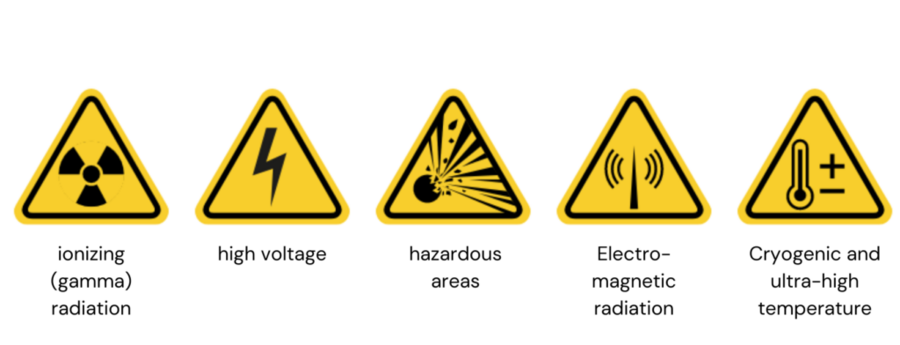
Fiber optic measurement technology comes with the big advantage of not being sensitive to environmental interference. Lightning strikes? No problem at all for the F108! Fiber optic sensors are intrinsically safe and can be put to use whenever the conditions are grim.
Why F108 and not any other fiber optic measurement product?
Unlike other fiber optic interrogators the technique used in Gantner Instruments’ F108 stands out with an unsurpassed measurement uncertainty, e.g. for temperature it is +/‑0.2 °C relative. Yes, you read it right – our fiber optic technology is that good! And what makes it stand out even more is that we took the technology and put it right there where you need it – a seamlessly integrated DAQ system.
- Plug in and measure: Start taking measurements from the moment you plug in.
- Measure faster: Single channel measurement speed of 10 kS/s
- Just another member of the family: Fully compatible with the Q.series X product line and GI.bench for easy set up & data acquisition
- 8 independent measurement channels
Do you want to learn more about Q.series X F108?
For further information visit our F108 website where you can download data sheets or contact your local Gantner Instruments sales representative.
More articles
Business Profitability and Edge computing
Our Gantner Instruments partner in the Philippines, DMS Engineering, organized a successful event on the 25th of November, 2022 at CEBU about using Edge Computing capabilities for Asset Monitoring to maximize business profitability.
Read more...Wendelstein 7-X Stellarator
After 9 years in construction, the stellarator (nuclear-fusion machine) of the Max Planck Institute in Greifswald generated plasma for the first time on December 10, 2015. The reactor had been gradually ramped up over the past 12 months. The event was given extensive coverage in the media. Gantner Instruments specially developed sensors for temperature and strain measurement for the project, which are otherwise unavailable on the market.
Read more...The A136 Strain Gage Amplifier: Redefining Precision Measurement
The new I/O module for 1kOhm strain gages and semiconductor-based sensors that require 10V excitation.
Read more...The Story Behind GI.blop: A home-brewed NEIPA Christmas treat from Austria
Christmas is approaching, and with it comes the festive season of sharing and special gestures. This year, we at Gantner Instruments wanted to give our customers and partners something unique for the holidays. So we created a special handcrafted beer we call GI.blop that is not only a great gift but also tells a story.
Read more...