


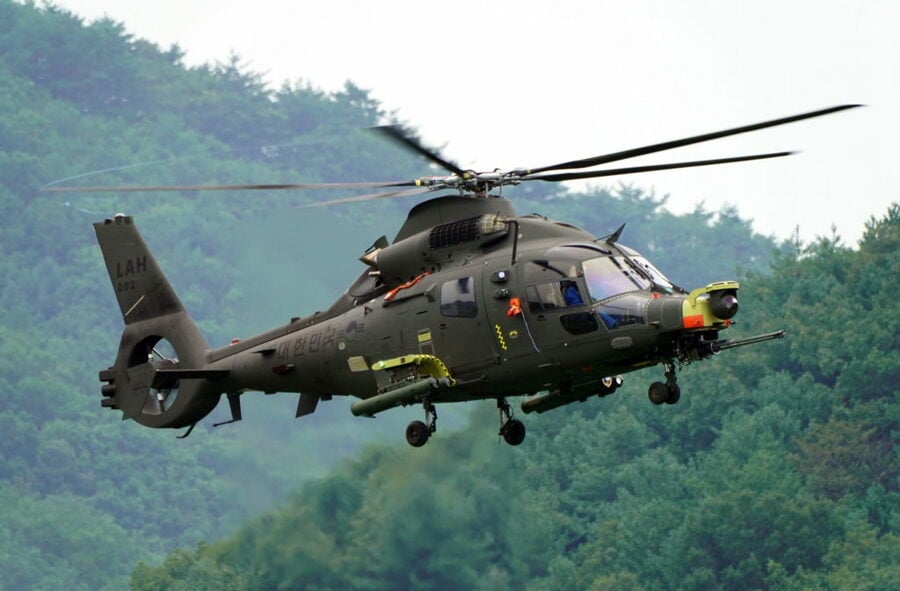
The Light Armed Helicopter (LAH) helicopter is scheduled to replace the South Korean Army’s ageing 500 MD and AH-1Ss attack helicopter fleets, while the Light Civil Helicopter (LCH) helicopter would be used by the country’s emergency services, coastal surveillance, and passenger transportation. Airbus Helicopters has been selected as the foreign partner to help KAI develop the 5-ton rotorcraft, which will be based on the Airbus Helicopters H155. The LCH version is expected to enter service in 2020, while the LAH’s service introduction is targeted for 2022.
For certification of the helicopter structure, the airframe components undergo a series of rigorous static and fatigue tests. During these tests simulated flight loads are applied to the airframe components by several servo-hydraulic actuators, controlled by a load control system. Strain gauges are used to measure strain due to elongation of the structure under load. The Q.raxx slimline DAQ system ensures time-synchronised measurement of both strain gauge and load control data. This allows for fast online analysis and metadata enrichment (load condition numbers, flight counters). Data is stored continuously and event-based at varying measurement rates up to 10 kHz.
The Q.raxx slimline system for KAI has been configured to acquire up to 512 strain gauges. Each 19” 1U slimline rack has 32 measurement channels coming with RJ45 sockets. All measurement channels can be individually configured for full-, half- or quarter-bridge configuration. For quarter-bridge measurements each input channel has two internal completion resistors. The resistors have been specially selected to have a best in class Temperature Coefficient of Resistance (TCR). This is to ensure minimal temperature drift during long test runs. On top of that Gantner’s Online Compensation Signal functionality automatically corrects for errors due to lead wire resistance, even during the measurement itself. There is therefore no need for manual shunt calibration.
Besides the technical advantages, Gantner’s long list of customer testimonials and exceptional support program – where you can directly speak with a qualified engineer and not a helpdesk – made KAI select the Q.raxx slimline for their upcoming test program. After Airbus Helicopters, another rotary wing aircraft OEM relies on Gantner Instruments!
Click here for more information about our capabilities for aerospace structural testing.
About Korea Aerospace Industries Ltd.
Korea Aerospace Industries, Ltd. manufactures and sells fixed and rotary wing aircrafts, and airframe components in South Korea. The company develops supersonic jets; airfield controlled and basic trainer aircrafts; amphibious, medical evacuation, police, maritime police, and utility helicopters; unmanned air vehicles; small civil air vehicles; and aero structures. It also provides aircraft maintenance, repair, and overhaul services; aircraft training systems; and multi-purpose satellites, as well as core-parts for satellites. The company was founded in 1999 and is headquartered in Sacheon, South Korea.
More articles
One-Click Cloud Connectivity – Real-Time DAQ in the Cloud
Historically, connecting your data acquisition (DAQ) system to the cloud involved complex networking setups, manual configurations, and tedious coding. With GI.bench, cloud integration is now seamless—pair your controller to GI.cloud with one click, making secure, remote data access easier than ever before.
Read more...Introducing GI.bench – Enhanced DAQ Capabilities for Engineering Excellence
Engineers and technicians often have a lot of problems when they are dealing with complicated data acquisition setups. These setups can include large amounts of data, the use of different devices, and the need for information in real time. Addressing these challenges head-on, Gantner Instruments proudly announces the latest evolution of our industry-leading software, GI.bench.
Read more...GI.bench is OUT!
We continue to improve our GI.bench data acquisition software with a strong focus on making it a scalable platform that is easy to use for both small high-speed measurement and high-channel-count, mixed-signal data acquisition applications.
Read more...Q.series X A142
Universal I/O module with analog output for closed-loop control applications
Read more...