
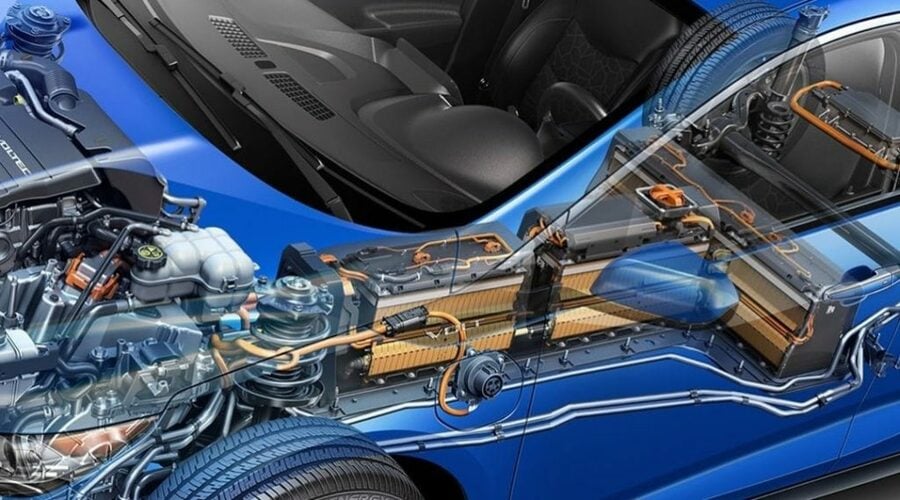
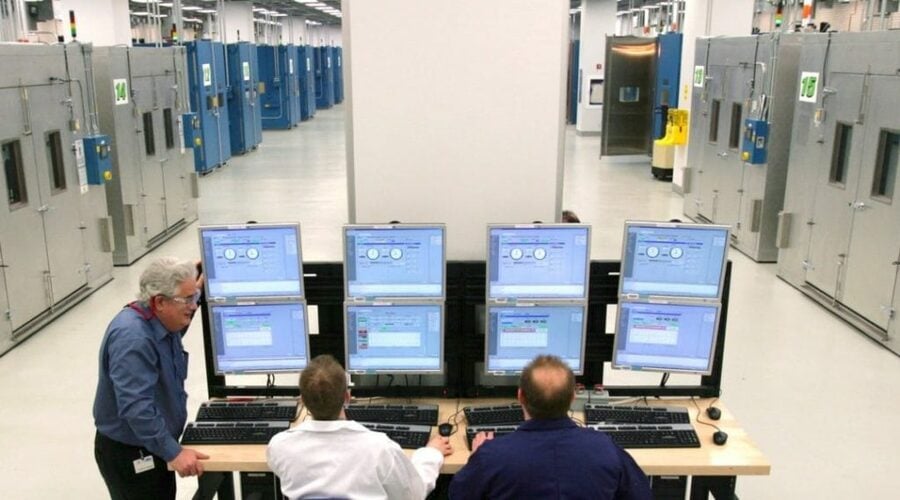
Our partner, A&D Technologies, was chosen by GM to supply the automation system for the test benches in GM’s, state-of-the-art battery testing laboratory. A&D chose e.series test & measurement modules, by Gantner Instruments, for the battery testing system.
Gantner industrial test & measurement, data acquisition modules were selected by A&D to provide the flexibility, reliability, precision and simple handling required by GM with the following key features:
- High Accuracy Distributed I/O
- Up to 24-bit A/D Resolution
- Complete Signal Filtering/Conditioning
- Flexible Digital Measurements
- RS485 Fieldbus Interface – Profibus-DP, Modbus-RTU, ASCII
- Galvanic Isolation
- Robust Design for Industrial Environments
- Temperature Stability at Measurement Range -20°C to +60°C
- Power 10 – 30 VDC
For more information about this application, click here: Application Note
More articles
Bridge Monitoring: The Cornerstone of Tomorrow’s Sustainable Infrastructure
A modern infrastructure enables us to organize mobility more sustainably, transport goods and commodities in a climate-friendly way and take advantage of the opportunities offered by digitization. Doing without it is not an option.
Read more...Sensor Shenzhen 2026
Curious about where the sensor industry is heading next? Discover how rapid innovation, global growth, and cutting-edge measurement technologies are shaping the future at Sensor Shenzhen 2026.
Read more...Gantner Instruments Environment Solutions celebrates its 10th company anniversary and starts with a ground-breaking ceremony for the construction of another company building
Over the past ten years, Gantner Instruments Environment Solutions GmbH has grown into a global market leader of monitoring and control solutions for large-scale solar systems.
Read more...Wendelstein 7-X Stellarator
After 9 years in construction, the stellarator (nuclear-fusion machine) of the Max Planck Institute in Greifswald generated plasma for the first time on December 10, 2015. The reactor had been gradually ramped up over the past 12 months. The event was given extensive coverage in the media. Gantner Instruments specially developed sensors for temperature and strain measurement for the project, which are otherwise unavailable on the market.
Read more...