
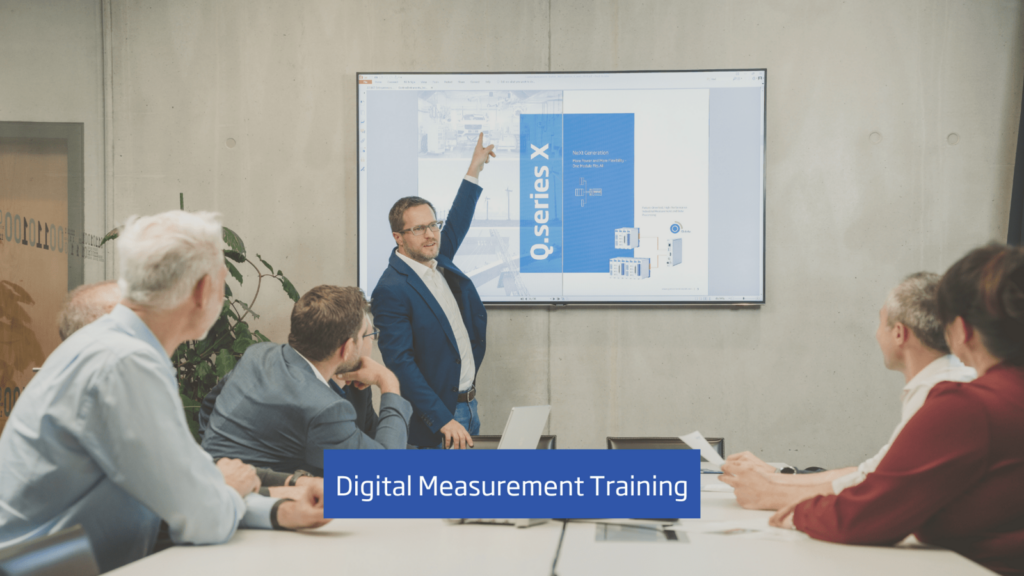
Dates and Duration
23rd November 2023, 09:00 a.m. – 24th November 2023, 04:30 p.m. (2 Days)
Location and Instruction
Available onsite at Ostfildern or via an interactive online platform.
Instructor: Bernhard Rennhofer, Gantner Instruments
Exploring the Universe of Digital Measurement Technology
Digital measurement technology has dramatically evolved over the recent years, transforming into an indispensable asset across myriad technical applications. It equips us with the capabilities to accurately capture and process measurement data, laying the groundwork for diverse applications such as automation technology, aviation, automotive manufacturing, drive technologies, construction, innovative energy storage solutions, research and development, and beyond. But what lies at the heart of digital metrology?
Aims of the Course
This comprehensive course unravels the principles behind electronic or digital measurement technology. You’ll explore electronic functions including AD-converters, DA-converters, sampling systems, and more, and gain the skills to design and construct corresponding circuits. Beyond mastering the theoretical foundations, you will also get to see these principles come to life through hands-on experiments. By the end of the seminar, you’ll be adept at applying the knowledge you’ve acquired directly into your professional environment.
Course Schedule
Thursday, November 23 and Friday, November 24, 2023
9.00 a.m. to 12.15 p.m. and 1.15 p.m. to 4.30 p.m.
Course Coverage
- Basic measurement concepts and units (SI units)
- Understanding measurement signals (both digital and analog)
- Exploring AD/DA converters
- Delving into Delta Sigma and SAR converters
- Introduction to Multiplexers
- Diverse measurement methods (Single Ended, Differential, Shielding)
- Characteristics of digital measurement (Resolution, Accuracy, SNR)
- Overview of fault continuation according to GUM
- Measurement of electrical and non-electrical quantities (voltage, current, power, acceleration sensors, resistance, temperature, frequency)
- Absolute encoder insights
- Storage and evaluation of measurement data
- Data logging and analysis
- Overview of Real-time vs. non-real-time systems
- Understanding Fieldbus (Profibus, EtherCAT, Profinet, CAN)
- Exploring IIoT – Industrial Internet of Things (MQTT, OPC-UA)
- Introduction to API and programming interfaces
Ready to step into the future of digital metrology?
More articles
Q.series demo at European Rotorcraft Forum
From September 5 – 8, Gantner participated in the 42nd edition of the European Rotorcraft Forum. The event was held in Lille, France.
Read more...Vibration and High Voltage Testing on Electric Metro System in Singapore
ALSTOM Transport Singapore is a promoter of sustainable mobility, Alstom Transport develops and offers the most comprehensive range of systems, equipment and services in the rail sector. Alstom Transport manages all aspects of transport systems, including rolling stock, signalling and infrastructure, as well as offering its clients turnkey solutions.
Read more...Testing of Dynamic and Strength
During operation of wind turbines high dynamic loads are considered. Therefore, static and dynamic strength and fatigue analysis are absolutely necessary on rotor blades of wind turbines.
Read more...Webinar – Essential Test & Measurement Technologies
Engineers face significantly complex challenges when deciding which future-proof, robust, and expandable data acquisition systems are best for their application(s). Thankfully three industry experts from Gantner Instruments will be presenting in a series of webinars hosted by our Canadian partner, Hoskin Scientific, to help make the DAQ selection process a little bit easier.
Read more...