
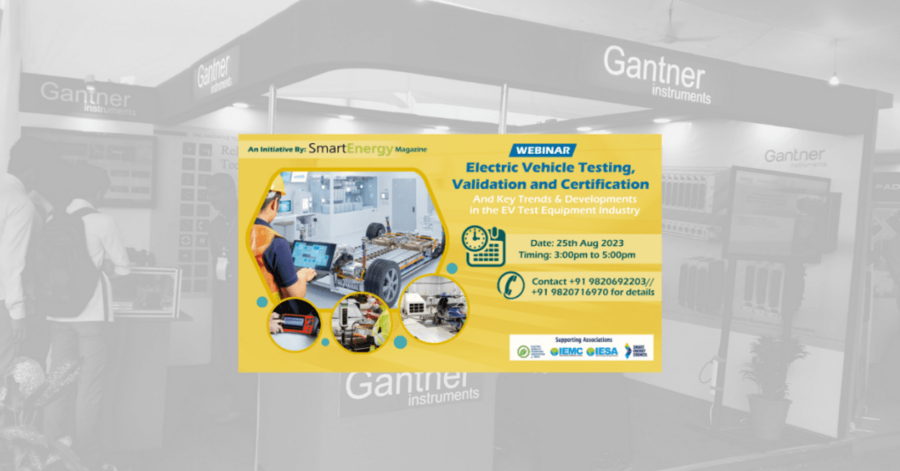
Electric vehicle (EV) testing goes beyond homologation testing for the vehicles and their components. It also covers the charging interfaces and the associated systems that enable EVs, charging stations, and back-office systems to communicate with one another, known as interoperability or conformance testing. Battery packs and the modules they are made of, containing large numbers of battery cells, are a source of energy that can be a potential hazard and, consequently, must be tested. Additionally, the conformance testing of all electrical components, such as plugs, cables, connectors, wiring, and switches, is an important step in electric vehicle testing. The Webinar will highlight EV and authorized agencies’ different testing and certification requirements. It will also deliberate on the EV test equipment industry and discuss technical advancements in EV test equipment, evolving market segments, the latest product developments, and the key drivers accelerating the growth of the EV test equipment industry.
The webinar will deliberate on the following topics:
- Standardization efforts, government policies & regulatory framework in India
- Testing and Accreditation/Approvals, also called as Homologation of EVs in India; Component approval, system approvals, whole vehicle type approval
- Charging types, charger testing, and certification
- Battery safety regulation; Battery Performance and safety testing
- Market overview of electric vehicle test equipment market: Key Market Trends, Growth Factors, and Opportunities
- EV battery testing technology, challenges, and solutions
- Upcoming trends of EV test equipment market
- New test methodologies are needed for effective, efficient, and accurate methods of testing EV systems
- New and advanced battery testing systems/platforms/software
- Testing vehicles according to Indian emission norms, the European Emission Standards (EEC), and the US Environmental Protection Agency (EPA) emission regulations
- Challenges & Solutions in maintaining a balance between high cost and performance of the test
Early Confirmed Speakers:
- Rajaram T R – Country Head- INDIA, Gantner Instruments
- Shrikant Gundu – Assistant Manager, Innovation Team, iASYS Technologies
- Rutuj Undale – Research and Development Engineer, Innovation Team, iASYS Technologies
Webinar Schedule:
Date: 25th Aug 2023
Time: 3:00 pm to 5:00 pm
Platform: Zoom Register @ Rs.1999/- Rs.199/- Only!
This Webinar will shine a light on not just the current situation and challenges facing mass adoption and deployment of EV infrastructure but on how we transition to where we need to be in the next 5 years and beyond!
Take advantage of the Opportunity to be part of the Deliberation and to Connect & Network with Leaders and Professionals from the EV Industry.
Contact for appointments
Rajaram T R
Country Head – India
raj@gantnerinstruments.in
We would be pleased to meet you at the webinar!
More articles
Introducing License Flexibility: GI.bench’s Latest Update Adds Dongle Support
We are excited to announce the newest enhancement to GI.bench. With the introduction of License-Dongle support and several minor improvements, GI.bench continues to evolve with functionality that anticipates and meets the evolving needs of professionals in the field.
Read more...Integrated Video and Data Logging – Enhanced Context and Analytical Depth with GI.bench
When analyzing measurement data, numbers alone often leave unanswered questions, particularly during unexpected events. GI.bench solves this challenge by integrating synchronized video recording directly with your measurement data, providing powerful visual context and significantly enhancing analytical clarity.
Read more...The Independent Graphical Developer Conference
11th - 13th September | Stuttgart, Germany Catch us at GDevCon, the premier independent conference dedicated to graphical developers! Taking place from September 11th to 13th, GDevCon 2024 is an unparalleled event designed to bring together the brightest minds in graphical programming.
Read more...International Rail Coach Expo 2026 (IRCE2026)
The International Rail Coach Expo 2026 (IRCE2026) will take place from March 12–14, 2026, at Integral Coach Factory (ICF) Stadium in Chennai.
Read more...