
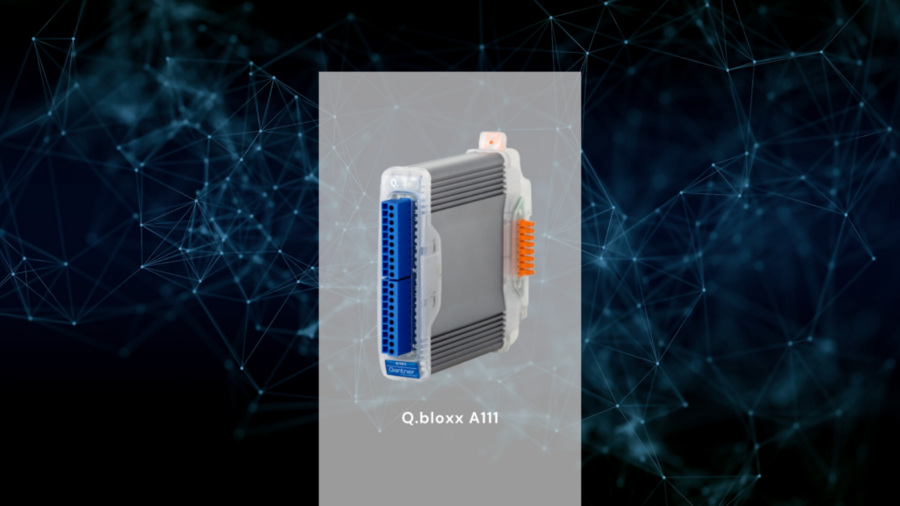
The Key features:
- 4 galvanic isolated analog input channels
IEPE sensors/voltages - Fast high accuracy digitalization
24 bit ADC, 100 kHz sample rate per channel - Signal conditioning
16 virtual channels, linearization, digital filter, average, scaling, min/max storage, RMS, arithmetic, alarm - RS485 fieldbus interface
up to 48 Mbps: LocalBus up to 115.2 kbps: Modbus-RTU, ASCII - Connectable to any Test Controller
e.g. Q.station, Q.gate, or Q.pac - Galvanic isolation
channel to channel to power supply and to interface Isolation voltage 500 VDC - Electromagnetic Compatibility
according EN 61000-4 and EN 55011 - Power supply 10 to 30 VDC
- DIN rail mounting (EN 60715)
For more information about Q.bloxx A111 Measurement DAQ , click here: IEPE Sensor/Voltage Measurement DAQ A111
More articles
Webinar – Crate.io + Gantner Instruments: Real-time energy grid control based on big data
With the increase in renewable energy sources, the challenge for electric grid operators to keep grid frequencies stable has become even more significant. Constant data collection is essential for modern control technology and makes it possible to execute controls more quickly, whereby the use of smart grids can be further optimized.
Read more...Gantner on expansion course
In 2014 Gantner Instruments GmbH moved into its new, energy-efficient company building in Schruns. The modern building with an area of 1000 m² has been designed from the beginning to offer the possibility of extension. This option was used in 2017 by the company, which has a steady double-digit growth per year since its inception.
Read more...Force monitoring improves efficiency of Airbus’ Final Assembly Line
In November 2016 the Airbus A350-1000 flew for the very first time. The A350-1000 is part of the A350 XWB family and is Airbus’ largest and most powerful twin-engined airliner ever. Airbus began the assembly of the A350-1000 in September, 2015, less than a year after the first delivery of the A350-900. For maximum flexibility, the existing A350 XWB Final Assembly Line (FAL) can be used for both A350-900 and A350-1000 models.
Read more...Crate.io presents Gantner Edge computing devices and GI.cloud at InteractiveWest
Our Edge computing devices and our new GI.cloud was presented by our partners Christian Lutz and Jodok Batlogg (founders of Crate.io).
Read more...