
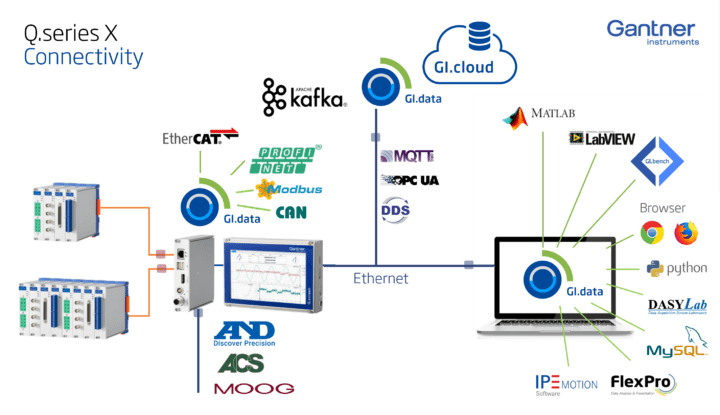
On Thursday, April 30th at 2:00pm ET, our partner FLW Southeast will be hosting a 30 minute webinar presented by Joseph Daniels and Bernhard G. Gruber of Gantner Instruments. Both will cover the key items that engineers should consider when evaluating new DAQ systems – from signal conditioning and I/O distribution to multi-party configuration to real-time monitoring and Cloud storage capabilities. Joseph will also review Gantner’s new Q.series X system and how it can meet these challenges as well as position engineers for future expansion and new technologies implementation

Event
Top Considerations for Selecting a Data Acquisition System for Testing Application
Webinar
April 30, 2020
More articles
Standalone E-drive testing in 3 simple steps
Automobiles have a variety of electrically operated drives. Be it the sunroof, the window lifter, the seat adjustment or the trunk lid, everywhere you look, you’ll find electric motors that provide us comfort in our cars.
Read more...6 Tips for Stress-free Strain Measurement during Fatigue Testing of Aircraft Structures
Strain is the single most important measurement during aircraft fatigue testing. The accuracy and precision of strain gauge measurements is of the greatest importance to exactly determine the durability and damage tolerance of a structure. The higher a structure is in the ‘pyramid of test’, the higher the test complexity, number of measurement channels, and data produced. On top of that the risk in terms of time delay and cost associated to a test program increases more than proportional with the increase in test complexity. Here are six tips to help you choose the right data acquisition system for your fatigue test:
Read more...3 Trends in testing you can’t ignore any longer
Testing is an agile business by its core definition. The structures and systems to be tested, whether it is in the automotive, aerospace, energy or civil engineering segment, keep evolving quickly and the data acquisition system needs to keep pace with it. At the same time not every new, hot trend will change your tomorrow.
Read more...Our new fiber optic measurement – without the hassle
Fiber optic measurement methods come with the advantage of being insensitive to interference from the environment. We all know that. What we also know is that actually using them in test and monitoring projects was not so easy so far. Either because there were steep learning curves or simply no integrated DAQ solution available. However, we have great news for you!
Read more...