



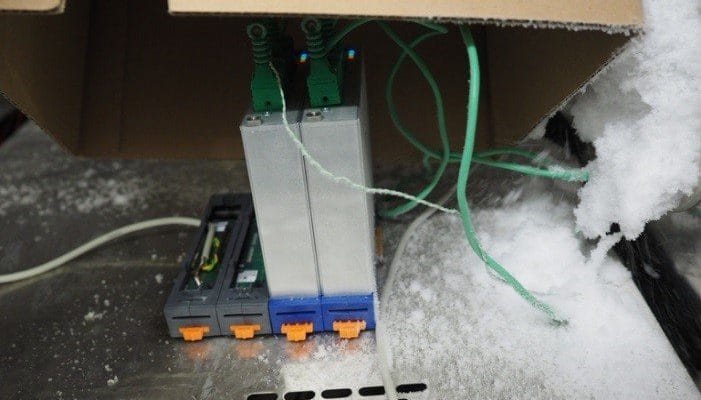
The Q.bloxx XL A104 TCK provides 8 channels for thermocouples (here as Type K, NiCr/Ni) with standard miniature front sockets.
During a day in the climate chamber at -40°C it was completely frozen. After connecting with power supply to the I/O module it was delivering stable and precise measurement values. When temperature was increasing it passed dew point. We observed no impact on the measurement quality or from condensation during this phase. Our I/O module passed this test successfully – even when the datasheet recommends only -20°C operating conditions.
More articles
Introducing License Flexibility: GI.bench’s Latest Update Adds Dongle Support
We are excited to announce the newest enhancement to GI.bench. With the introduction of License-Dongle support and several minor improvements, GI.bench continues to evolve with functionality that anticipates and meets the evolving needs of professionals in the field.
Read more...Designing SHM as Long-Term Measurement Infrastructure
Across the United States, bridges, tunnels, dams, and large industrial structures are being pushed beyond their original design life and asked to carry higher traffic volumes, heavier freight, and more frequent extreme events. At the same time, the U.S. regulatory and asset-management environment still depends heavily on periodic inspection programs and documented condition data.
Read more...GI.service Asset performance optimizer
With the significant investments being made in distributed renewable energies, the global energy market is changing from a central supply concept to a decentralized system. This transition is presenting companies in the energy market with various strategic and technical challenges to achieve efficient operations.
Read more...Q.series interface with the Moog Aerospace Test Controller
The amount of data generated in an aircraft structural test program continues to grow. The density of load introduction points (actuators) and sensors (strain gauges, thermocouples, LVDTs) on a test article is increasing progressively and model validation requires higher data sample rates to capture more detail. The risks and costs involved in aircraft validation and certification are significant, and the requirement for quick entry-into-service is high. To minimize the impact of retrofitting in-service aircrafts, the ability to generate test results quickly is crucial to the success of a test program.
Read more...