

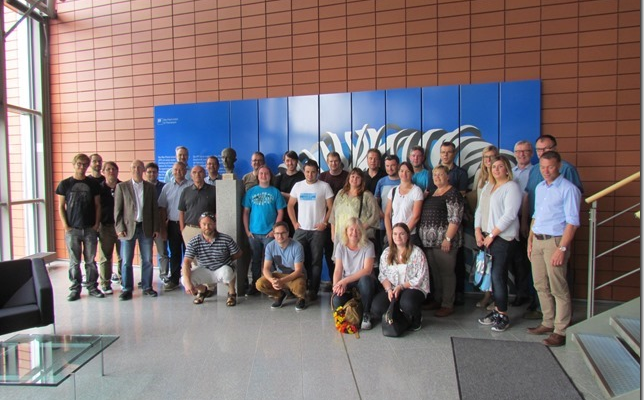
A very special hightlight was our vist on Monday to MPI Greifswald. MPI is concerned with investigating the principles underlying a power plant, which – like the sun – will produce energy from the fusion of light atomic nuclei.
Gantner Instruments specially developed sensors for temperature and strain measurement for the project, which are otherwise unavailable on the market. Mr. Kallmeyer – one of the scientists – has declared and shown us much – so we have obtained all a good overview about one of our biggest projects.
More articles
3 Trends in testing you can’t ignore any longer
Testing is an agile business by its core definition. The structures and systems to be tested, whether it is in the automotive, aerospace, energy or civil engineering segment, keep evolving quickly and the data acquisition system needs to keep pace with it. At the same time not every new, hot trend will change your tomorrow.
Read more...Python Integration – A New Level of Automation and Analysis
Engineering teams rely on powerful, customizable tools to handle increasingly complex test scenarios. GI.bench now includes integrated Python scripting, empowering engineers to automate measurement workflows, perform advanced real-time analyses, and seamlessly integrate with external software. This feature leverages Python's rich ecosystem, ensuring flexibility and efficiency in test and measurement projects.
Read more...Q.series X A107 SV: Universal Measurement Module with Sensor Supply
Gantner Instruments' Q.series X A107 4 x Lemo 2B SV module is an adaptable and precise universal measurement module designed for engineers who need accurate data acquisition in distributed installations. This module, which is part of the modular and scalable Q.series X product family, now includes programmable sensor supply voltage and current limit capabilities per channel.
Read more...Q.series X A156
New 4-channel carrier frequency amplifier for inductive transducers and strain gages
Read more...