

Gantner Instruments is launching a brand new Optical Gage Amplifier that offers all the benefits of fiber optic measurement, but without the hassle!
What is the F108?
The new F108 Optical Gage Amplifier combines unique fiber optic sensor technology with the modularity and versatility of the Q.series X product line. For quick and easy setup you can use GI.bench and even combine it with GI.cloud for cloud-based storage and monitoring.
The Q.series X F108 is designed for fiber optic π-phase-shifted Bragg grating (πFBG) for high resolution measurement. A laser with a narrow tuning range (~4 nm, nominally ~1548-1552 nm) is used to lock to the dip seen in a πFBG and to track that point as the sensor is subjected to changes in temperature or strain. Or in other words, smaller signal peaks can be measured and that is what makes the measurement more accurate and precise.
What do you have to do to use the unique optical sensor technology for your tasks in DAQ projects? You simply have to plug in… and you can start to measure!
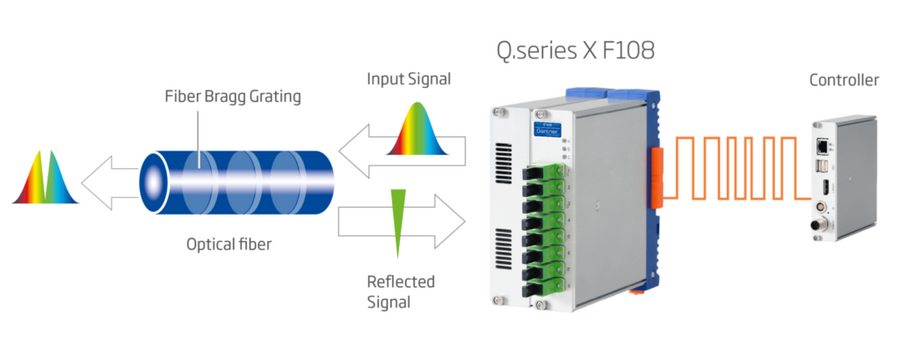
We at Gantner Instruments optimized the signal’s way from sensing element to transducer to signal conditioner, to address a wide range of precision measurement challenges.
In which environments can you use the F108?
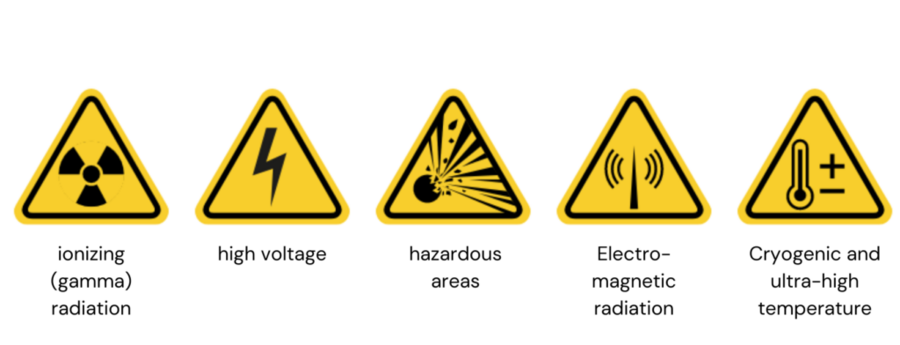
Fiber optic measurement technology comes with the big advantage of not being sensitive to environmental interference. Lightning strikes? No problem at all for the F108! Fiber optic sensors are intrinsically safe and can be put to use whenever the conditions are grim.
Why F108 and not any other fiber optic measurement product?
Unlike other fiber optic interrogators the technique used in Gantner Instruments’ F108 stands out with an unsurpassed measurement uncertainty, e.g. for temperature it is +/‑0.2 °C relative. Yes, you read it right – our fiber optic technology is that good! And what makes it stand out even more is that we took the technology and put it right there where you need it – a seamlessly integrated DAQ system.
- Plug in and measure: Start taking measurements from the moment you plug in.
- Measure faster: Single channel measurement speed of 10 kS/s
- Just another member of the family: Fully compatible with the Q.series X product line and GI.bench for easy set up & data acquisition
- 8 independent measurement channels
Do you want to learn more about Q.series X F108?
For further information visit our F108 website where you can download data sheets or contact your local Gantner Instruments sales representative.
More articles
Three steps to the Internet of Things (IoT) or: Where is analog big data derived from?
The break-up into the new era of Internet of Things (IoT), industry 4.0 or cloud computing takes an impressive pace and is also in several industrial applications irresistible. The industry with its huge amount of machines and components of divers size, value and function is faced by one big challenge: data from all these assets needs to be gathered and analyzed.
Read more...Bridge Monitoring: The Cornerstone of Tomorrow’s Sustainable Infrastructure
A modern infrastructure enables us to organize mobility more sustainably, transport goods and commodities in a climate-friendly way and take advantage of the opportunities offered by digitization. Doing without it is not an option.
Read more...GDevCon 4 Glasgow
Immerse yourself in the vibrant world of graphical programming at GDevCon 2023 on the 20th and 21st of September, from 9:00 am - 6:00 pm, at the esteemed Glasgow Science Centre, Scotland. This conference is a must-attend event for anyone striving to push the boundaries in the fields of engineering and technology.
Read more...Measurement Data in the Cloud and IT Security Aspects
The GI.cloud concept acquires and stores data of many decentralized data acquisition systems like Gantner Instrument’s Q.Station. IT Security is an increasingly important aspect to secure the communication and data transfer between the acquisition system and the cloud server.
Read more...