



You probably know that already, because you have seen it over and over again, but you don’t want to jump on every bandwagon each time. And yet there are developments in data acquisition that are here to stay and will have an impact on your test setup and the way you work. If not today, then tomorrow. So let us introduce you to what we think are the top 3 trends in testing that will not go away and are worth a closer look.
1. Speed
The faster the better. Or let’s say the faster you measure, the more data and the higher the resolution. High speed measurement is an emerging trend, not only in the automotive industry, but also in the growing market of electric drives. Whether it concerns testing of (hybrid) electric propulsion systems , electric drivetrains or batteries – to test and measure electrical parameters faster and with lower noise is a trend you should definitely keep an eye on.
If you are familiar with high speed measurement, then you are familiar with the big challenge that comes along with it – the avalanche of data. The faster you measure, the higher is the data volume that needs to be handled and turned into meaningful insights.
Therefore, pay attention to data acquisition solutions that offer big data analytics, data management, and data storage technologies that are easy to adapt to the changing requirements for testing.
2. Smart Data Handling
To work faster and more efficiently you want to be able to monitor and respond to data in real-time, regardless of the data volume. Depending on the type of measurement, the duration and sample frequency, an overwhelming avalanche of data will hit you.
Your challenge ahead is not only to collect the data, but to store and analyze it in the most reliable way. To reach this goal you will need a solution that offers a faster and more efficient handling of large data streams.
One way a smart data backend can operate with is for example to distinguish between hot and cold data and to handle those types differently. Raw data and data that is less-frequently accessed and only needed for auditing or test post-processing (“cold data”) is stored in a distributed streaming platform that scales extremely efficiently. If you have to store, process and calculate new variables from hundreds of thousands of samples per second and from hundreds of channels at the same time, this distributed streaming architecture will show its strength and power.
So-called “hot data”, measurement data that must be accessed immediately for analysis, is provided in a time series database. This database stores data securely in redundant, fault-tolerant clusters. All measurement data is automatically backed up. Flexible data aggregation ensures that measurement data is continuous processed from the streaming platform to the database at predefined sample rates.
However, the same data can be replayed and stored at a higher sample rate in case detailed analysis around an unexpected event or specimen failure is required. This approach minimizes the investment cost for IT and storage infrastructure in the test lab, whilst maintaining the necessary computing performance for test-critical data analysis tasks.
No matter the exact solution, to guarantee your smooth surf on any data avalanche ahead you will rely on a smart data backend, that contains services for connectivity and is adaptable and scalable for high-performance edge computing services.
As a sweet side benefit a distributed and scalable data backend offers even more control over your cost-performance ratio as you can access your test setup and data from anywhere around the globe. Your engineering team might not be in one place or your biggest client will need support quickly, no matter the time zone: All of this can be easily provided through scalable data backends.
3. Modularity
Speaking of cost-performance ratio – this trend is the holy grail we are all looking for during our working life. Keep running costs down while delivering the best performance. But how can you succeed in doing so in today’s fast-paced market? The key to achieve an optimal cost-performance ratio in testing is called: modularity.
A modular approach to your test equipment offers you scalability and flexibility. Maintaining a basic hardware and software platform that can easily be extended with new technologies like high-speed or fiber-optic measurement, reduces capital investment. Look out for modular solutions that are backward compatible and will therefore extend equipment life and lower maintenance cost.
Conclusion
The 3 trends you can´t ignore any longer all point towards the same direction – the structures and systems to be tested change quickly and your data acquisition system needs to keep pace with it. Big data analytics and a modular approach to your test set up will clear the way to meet your future needs in testing and measurement.
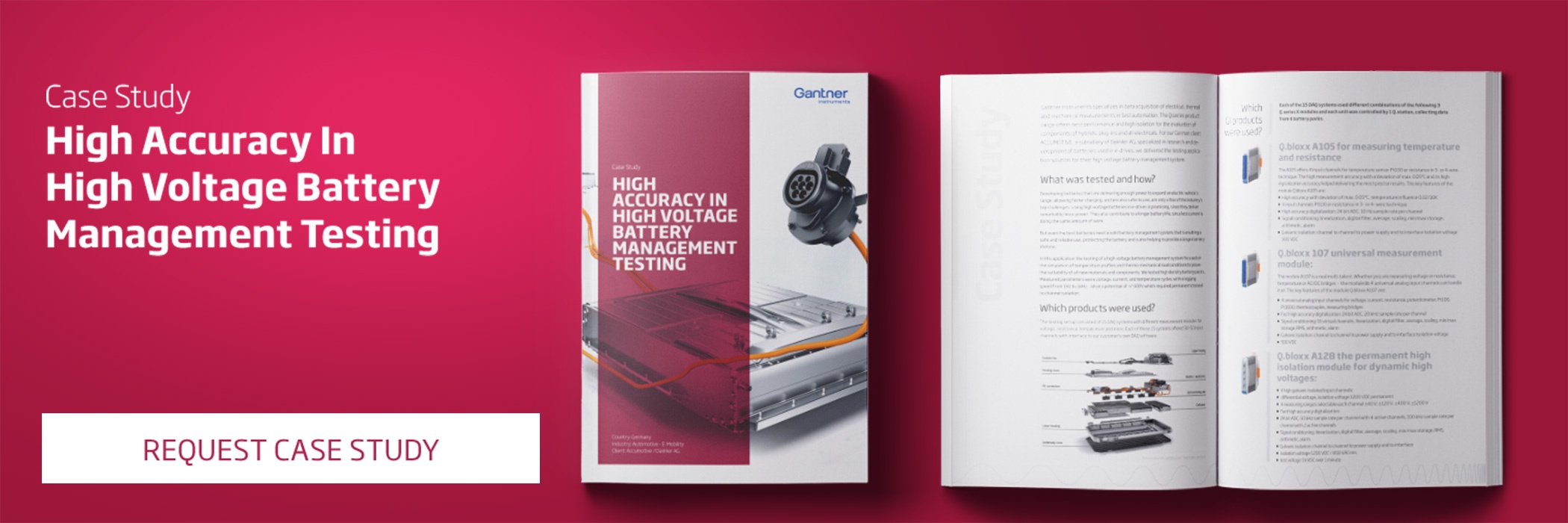
Download our new case study to find out how we tested high density battery packs for our German client ACCUmotive, a subsidiary of Daimler AG. The testing of this high voltage battery management system focused on the simulation of temperature profiles and thermo-mechanical load conditions. The testing was set up to prove the suitability of all new materials and components.
More articles
TestRig 2026
The TestRig 2026 takes place on March 11–12, 2026, and is an interdisciplinary conference dedicated to the design and operation of modern test benches. It brings together experts from mechanical engineering, electrical engineering, sensor technology, actuators, and control and measurement systems. The focus is on test benches used to analyze vibration behavior, fatigue strength, and the reliability of technical systems.
Read more...EtherCAT performance combined with industry leading DAQ: 5 benefits you’re missing out on
We have compiled a list of the 5 most significant benefits of using an EtherCAT-based data acquisition system. If you’re not already familiar with EtherCAT, prepare to be enlightened. If you’re among the many engineers that use EtherCAT in your testing lab then you can consider this a confirmation of why you do what you do – and an excellent place to direct those who still think Industrial Ethernet is not suitable for high-performance testing applications.
Read more...Long term Volcano Monitoring – A field study
Monitoring volcano activity is an important issue in the mitigation of natural hazards. Recently, most fatal issues occurred on volcanoes with low-energy and moderate activity, making them attractive touristic places (e.g., the 2014 Mount Ontake eruption in Japan). For these types of volcanoes, monitoring involves multiphysics measurements on dense networks. Distributed networks of sensors must be easily adapted to the volcano’s evolving state and the appearance of new active areas like fumaroles or high heat flux in the soil.
Read more...Historic Ship, Modern Protection: Real-Time Force Monitoring Stabilizes Sweden’s Vasa Warship
The Vasa Museum in Stockholm houses Vasa, a 17th-century Swedish warship raised from the seabed in 1961. Almost completely preserved, she is both a cultural icon and a full-scale research platform for naval architecture, materials science, and maritime archaeology. But preserving a 400-year-old oak hull on land poses a critical structural challenge: without buoyancy, the ship’s weight is carried through discrete support points, and slow deformation has already been detected. To protect Vasa for future generations, the museum is replacing the original display cradle with an adjustable steel support system equipped with a real-time force monitoring and long-term structural health monitoring (SHM) solution.
Read more...