



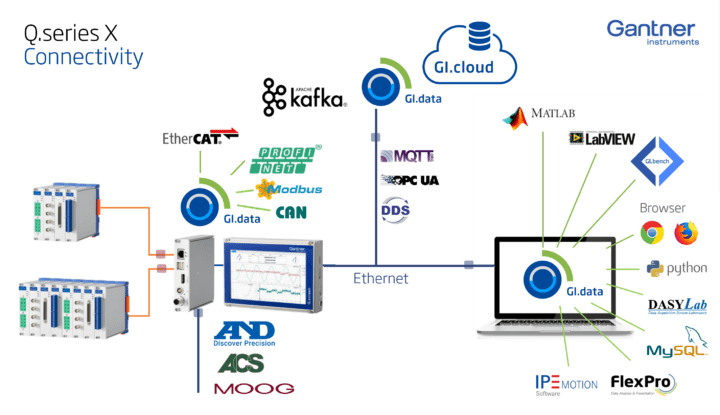
On Thursday, April 30th at 2:00pm ET, our partner FLW Southeast will be hosting a 30 minute webinar presented by Joseph Daniels and Bernhard G. Gruber of Gantner Instruments. Both will cover the key items that engineers should consider when evaluating new DAQ systems – from signal conditioning and I/O distribution to multi-party configuration to real-time monitoring and Cloud storage capabilities. Joseph will also review Gantner’s new Q.series X system and how it can meet these challenges as well as position engineers for future expansion and new technologies implementation

Event
Top Considerations for Selecting a Data Acquisition System for Testing Application
Webinar
April 30, 2020
More articles
Gantner Instruments Environment Solutions celebrates its 10th company anniversary and starts with a ground-breaking ceremony for the construction of another company building
Over the past ten years, Gantner Instruments Environment Solutions GmbH has grown into a global market leader of monitoring and control solutions for large-scale solar systems.
Read more...Force monitoring improves efficiency of Airbus’ Final Assembly Line
In November 2016 the Airbus A350-1000 flew for the very first time. The A350-1000 is part of the A350 XWB family and is Airbus’ largest and most powerful twin-engined airliner ever. Airbus began the assembly of the A350-1000 in September, 2015, less than a year after the first delivery of the A350-900. For maximum flexibility, the existing A350 XWB Final Assembly Line (FAL) can be used for both A350-900 and A350-1000 models.
Read more...Test Like You Fly, Fly Like You Test
When building a rocket there is a whole flight certification process, and qualification is an important part of that. It proves the hardware meets the requirements and performs the way it is designed to do. Of all parts of a rocket, the engine section is perhaps the most critical during launch. The weight of the massive rocket is pushing down, while the engines are pushing up with millions of pounds of thrust. Whether it is an engine for experimental rockets or for commercial spaceflight, adequate testing is critical to the success of each launch program.
Read more...Metro de Madrid Stays Ahead of Brake Problems
METRO DE MADRID is a railway company that provides public transportation services to Madrid and its metropolitan area. Currently, it is the most extensive metro network in Spain, with a length of 294 kilometers. With 302 stations, it is the third-largest network in Europe by kilometers, after those in London and Moscow. It has 2400 trains and makes an average of 650 million trips a year, with 350 million passengers.
Read more...