Austria | Germany | France | Sweden | India | USA | China | Singapore
Transform data into insights
Tips & Trends | 3 minutes Reading Time |

Transform data into insights

A monumental challenge for engineers is not just how to acquire data in testing, but how to store and preserve such large volumes of it

The electric vehicle testing community is having to deal with increasingly complex products and faster development cycles, meaning that test labs are under constant pressure. As such, the ability to efficiently analyze test data has never been more critical. Costs must be kept as low as possible, while growing amounts of data from sensors are processed. Engineers must monitor and analyze test data in real time, regardless of how much there is to sift through. It’s therefore no wonder that they are seeking new ways to improve testing efficiency and reduce risk of low quality data.

During acquisition, electrical and mechanical signals are measured at sample rates in the kilohertz range and need to be highly synchronized. These tests in particular generate an overwhelming amount of data. The real challenge is storing and preserving this data. The handling of such large volumes of structured and unstructured data requires an adaptive and scalable data back end. To cope with ever-changing requirements, setup configurations, parameter extensions and sample rates, a separation between hot and cold datais helpful.

‘Cold data’, which is less frequently accessed and only needed for auditing or post-processing, is stored in a distributed streaming platform that scales as needed. The ‘hot data’, which is accessed in real time for analysis, is provided in a NoSQL time-series database. This database stores readings securely in  redundant, fault-tolerant clusters. Flexible data aggregation ensures that the right granularity is available at any time. Data can then be replayed and aggregated in different ways for detailed analysis of test events. This approach minimizes IT operational costs and the storage infrastructure within the test lab.

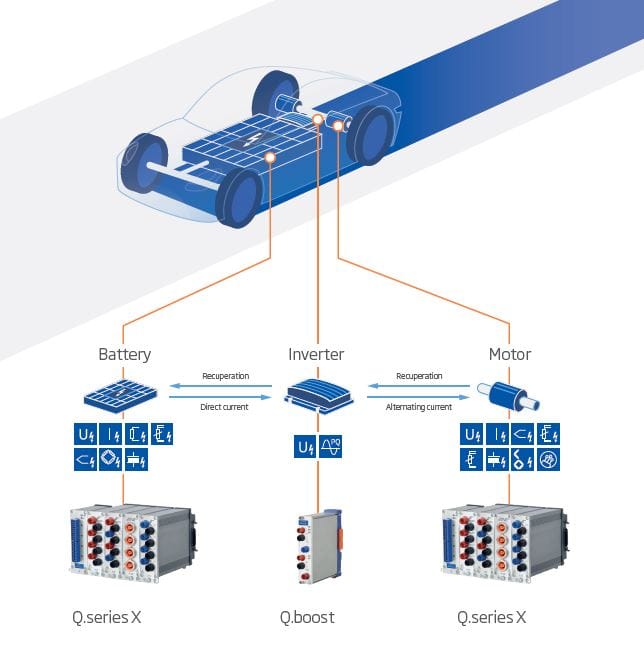
Electric vehicle powertrain testing is a typical use case where a scalable data back end offers significant advantages. A huge quantity of data is  generated, especially during real-time power and electric motor performance evaluation. Data rates can vary from 10 samples/sec up to 4,000,000 samples/sec. The challenge is storing all this data, while keeping it available on a 24/7 basis for rapid analysis of continuous and triggered data  streams.

To capture, analyze and store data, and ensure its availability for applications, Gantner selected Apache Kafka, a data streaming platform, to manage cold data; and the distributed database, CrateDB, to handle hot data. Working with this scalable data back end concept demonstrates the power of combining edge computing, big data handling, and machine learning.

infoChart-e-drive-powertrain

Test labs use specialized control, monitoring and data acquisition systems, but often lack the necessary integration between these systems, which can lead to late fault detections in systems under test. Gantner’s philosophy is to provide customers with open interfaces to store data and send it wherever they need – enabling seamless integration with any monitoring, analysis and reporting tool.

For test labs outfitted with automated test systems, the company’s Application Programming Interface (API) provides a simple way of integrating the solution into their existing environments. Analysis and fault detection methods differ by application, so standardized interfaces for integrating with existing architectures, visualization methods and report routines are essential; for example, to accurately calculate power factor, apparent power, and reactive power from raw measurement data.

With an adaptive and scalable data back end solution, Gantner Instruments provides test labs with the platform needed to grasp, monitor, analyze  and react to any physical data in real time, regardless of the data volume – transforming data directly into insights.

Experience the new platform for modern and robust measurement setups

The GI.bench software platform combines faster test setups, project configuration and handling, as well as visualization of data streams in one digital workbench. It enables you to configure, execute and analyze your measurement and test tasks on the fly. Access live and historical measurements data anywhere.

GI.bench - monitor better & test faster

More articles

News

Webinar – Crate.io + Gantner Instruments: Real-time energy grid control based on big data

With the increase in renewable energy sources, the challenge for electric grid operators to keep grid frequencies stable has become even more significant. Constant data collection is essential for modern control technology and makes it possible to execute controls more quickly, whereby the use of smart grids can be further optimized.

Read more...
Success Stories

Airbus Helicopters Chooses Gantner to Upgrade their Fatigue Test Cells

Airbus Helicopters (formerly Eurocopter Group) is a global helicopter manufacturing and support company. It is the largest in the industry in terms of revenues and turbine helicopter deliveries. With the growth and advancement of their product offer, Airbus Helicopters identified a need to upgrade their component test benches at their newly enhanced manufacturing location in Donauwörth, Germany.

Read more...
Events

Seconds Matter: Real-Time Decisions for Smarter Energy Systems

The future of energy isn’t just about generating more power—it’s about using it smarter, faster, and more efficiently. The challenge? Energy systems are more complex than ever. Renewable integration, grid decentralization, and industrial energy demands are pushing operators to make split-second decisions that directly impact efficiency, stability, and cost.

Read more...
Events

Hands-On Measurement Technology at Stiegele 2025

On April 3–4, 2025, leading developers, manufacturers, and industry professionals will gather at Stiegele Datensysteme GmbH for the Symposium Messtechnik zum Anfassen (Hands-On Measurement Technology Symposium).

Read more...