
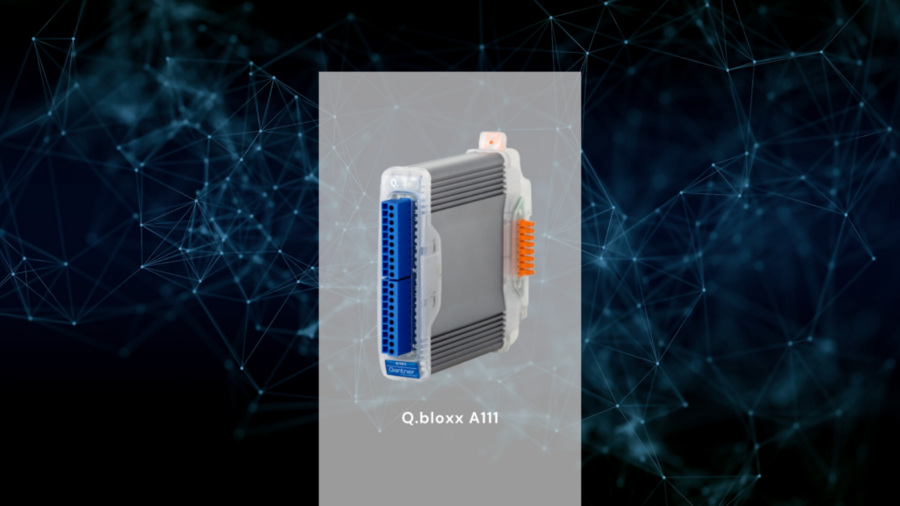
The Key features:
- 4 galvanic isolated analog input channels
IEPE sensors/voltages - Fast high accuracy digitalization
24 bit ADC, 100 kHz sample rate per channel - Signal conditioning
16 virtual channels, linearization, digital filter, average, scaling, min/max storage, RMS, arithmetic, alarm - RS485 fieldbus interface
up to 48 Mbps: LocalBus up to 115.2 kbps: Modbus-RTU, ASCII - Connectable to any Test Controller
e.g. Q.station, Q.gate, or Q.pac - Galvanic isolation
channel to channel to power supply and to interface Isolation voltage 500 VDC - Electromagnetic Compatibility
according EN 61000-4 and EN 55011 - Power supply 10 to 30 VDC
- DIN rail mounting (EN 60715)
For more information about Q.bloxx A111 Measurement DAQ , click here: IEPE Sensor/Voltage Measurement DAQ A111
More articles
Daily Meals for 300 Children
After establishing our company last year in India, we became aware of the Sri Karpagavalli Vidyalays Middle School, a school for 300 girls and boys ages 5 through 14. Not only do these children, coming primarily from the slums, lack educational material, they frequently do not even have elementary necessities like food.
Read more...High Performance Measuring Module D107 for Frequencies
The Q.bloxx D107 is a new measurement module for the acquisition of frequencies and incremental signals. Due to its fast signal conditioning capability with a clock speed of 288 MHz, the new module is suitable for extreme measurement of rotational speeds, which were not previously possible in this price range.
Read more...Designing SHM as Long-Term Measurement Infrastructure
Across the United States, bridges, tunnels, dams, and large industrial structures are being pushed beyond their original design life and asked to carry higher traffic volumes, heavier freight, and more frequent extreme events. At the same time, the U.S. regulatory and asset-management environment still depends heavily on periodic inspection programs and documented condition data.
Read more...The importance of modern data management
A new study by Gantner Instruments shows two opposing trends: aircraft structures are becoming increasingly complex, whilst development times need to be shortened. Test engineers are continuous being pressured to look for ways to reduce test time and risk.
Read more...