

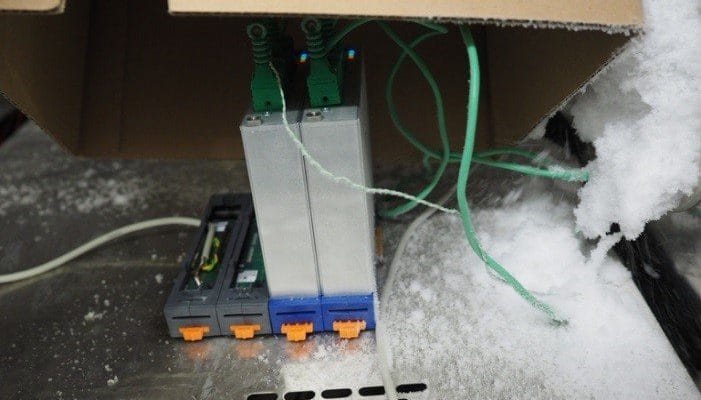
The Q.bloxx XL A104 TCK provides 8 channels for thermocouples (here as Type K, NiCr/Ni) with standard miniature front sockets.
During a day in the climate chamber at -40°C it was completely frozen. After connecting with power supply to the I/O module it was delivering stable and precise measurement values. When temperature was increasing it passed dew point. We observed no impact on the measurement quality or from condensation during this phase. Our I/O module passed this test successfully – even when the datasheet recommends only -20°C operating conditions.
More articles
Trapped in Ice
Arctic ice is disappearing — the question is how fast. Summer sea ice could endure 100 more years, or it could vanish later this decade, with disastrous consequences for the rest of the planet. To nail down the answer, an expedition to the top of the world has to uncover the complex physics of ice.
Read more...Automotive Test Automation
With an increasing pressure to reduce CO2 emissions, E-mobility is a fast-growing market. While keeping this in mind, Gantner Instruments successful Q.series product line offers the best performance with maximum flexibility, to meet the growing demand for E-Mobility Battery Testing and Battery Management Systems.
Read more...Hydrogen Future Conference
The Regional Hydrogen Future Conference will take place on 11 February 2026 in Augsburg and is organized by IHK Schwaben. The conference focuses on green hydrogen as a key driver for sustainable value creation resilient energy systems and climate friendly mobility. The event brings together experts from business politics and science and offers space for exchange networking and new ideas around the hydrogen economy.
Read more...AEWG General Meeting 2026
Connect with experts in acoustic emission technology and explore practical solutions for today’s measurement challenges in a collaborative environment.
Read more...